Hydrochloric Acid → 5-Chloro-2-(3-hydroxyphenoxy)benzonitrile
Reaction equation

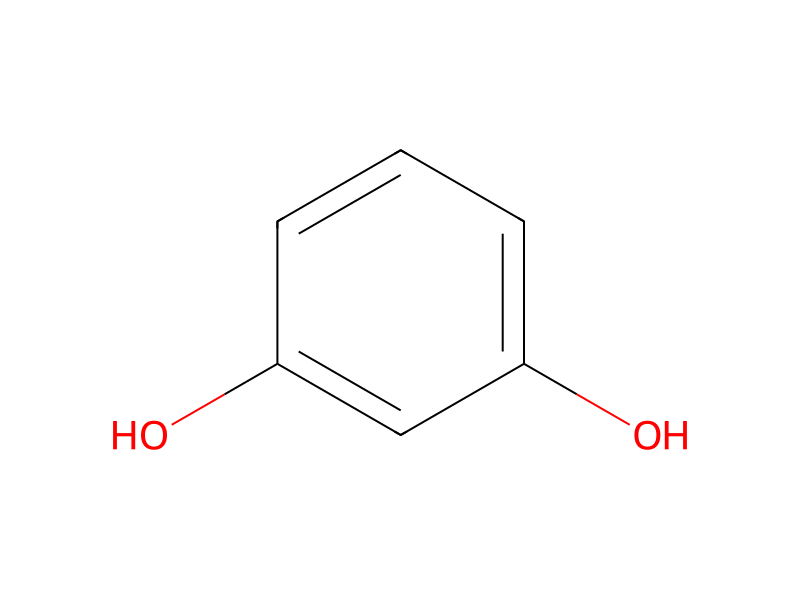
[C:1]1([CH:8]=[CH:7][CH:6]=[C:4]([OH:5])[CH:3]=1)[OH:2].[OH-].[K+].Cl[C:12]1[CH:19]=[CH:18][C:17]([Cl:20])=[CH:16][C:13]=1[C:14]#[N:15].Cl>CS(C)=O>[C:14]([C:13]1[CH:16]=[C:17]([Cl:20])[CH:18]=[CH:19][C:12]=1[O:2][C:1]1[CH:3]=[C:4]([OH:5])[CH:6]=[CH:7][CH:8]=1)#[N:15]Participants
6





Procedure
66 g of resorcinol are added to 220 ml of dimethyl sulphoxide. With stirring, 37.4 g of potassium hydroxide (powder) are added, whereupon the temperature rises to 55° C. The mixture is kept for 30 minutes at 60° C. and the 51.6 g of 2,5-dichlorobenzonitrile are added in portions. The reaction mixture is then stirred for 7 hours at 90° C. and, after cooling, poured into ice-water. The pH is adjusted to 6 with conc. hydrochloric acid and initially a brown oil precipitates, which soon becomes crystalline. Crystallisation from ethanol/-water yields 49.6 g of 3-(2'-cyano-4'-chlorophenoxy)-phenol with a melting point of 118°-120° C.
Workup
- customrises to 55° C
- stirringThe reaction mixture is then stirred for 7 hours at 90° C.
- temperatureafter cooling
- custominitially a brown oil precipitates
- customCrystallisation from ethanol/-water
Sources & evidence
- ORD record
- ord-3a00aab288f8408e9538f02bac6d9d3e
- Source dataset
- uspto-grants-1983_07
- Patent number
- US04394327
Reaction notes
Loading…