Acetone → L-Ascorbic Acid
Reaction equation

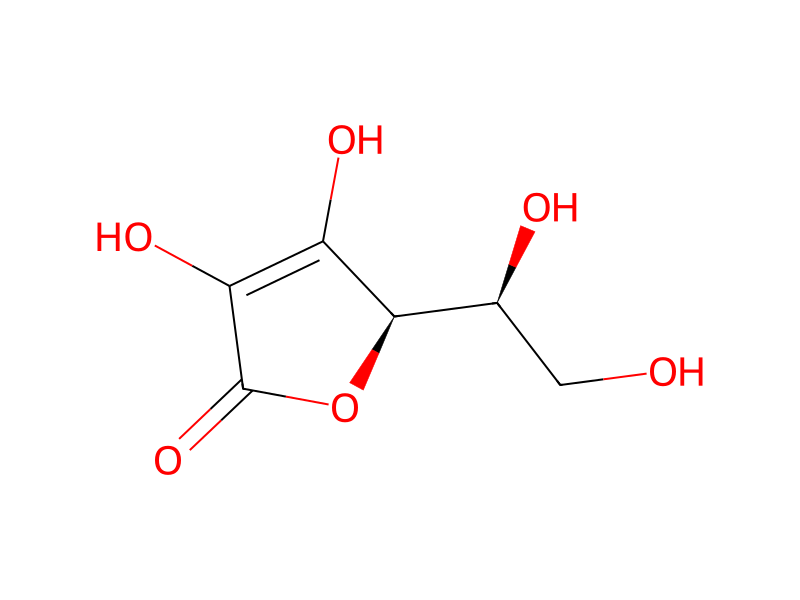
C1(C)C=CC=CC=1.CC(C)=O.Cl.[CH2:13]([OH:25])[C@H:14]([OH:24])[C@@H:15](O)[C@H:16]([OH:22])[C:17]([C:19]([OH:21])=[O:20])=[O:18]>[Cl-].C[N+](C)(C)CCCCCCCCCCCCCCCC.O>[O:20]=[C:19]1[O:21][C@H:15]([C@H:14]([CH2:13][OH:25])[OH:24])[C:16]([OH:22])=[C:17]1[OH:18]Participants
Reactant 4




Product 1
Reagents, catalysts & solvents 2


Conditions
- Temperature
- 60 °C
Procedure
To a mixture solvent of toluene (580 ml) and acetone (110 ml) dissolving therein hydrogen chloride (11.1 g) was added 2-keto-L-gulonic acid (content: 89.9%, water content: 8.4%) (100 g), to which were added 35% hydrochloric acid (11.8 g) (d=1.17, 4.1 g as HCl) and trimethylcetylammonium chloride (0.12 g). The water content in the reaciton mixture was calculated to be 16.1 ml (1.93 times as much in molar ratio relative to 2-keto-L-gulonic acid). The reaction mixture was heated to 60° C. and stirred for six hours, which was cooled to 20° C. and poured into water (1 l). The reaction mixture was stirred and left standing, followed by separation of the aqueous layer. To the organic layer was added water (400 ml) for re-extraction. The aqueous layers were combined. The L-ascorbic acid produced was quantitatively determined by means of a high performance liquid chromatography to find that the compound was produced in an amount of 74.6 g (yield: 91.5%), while 2-keto-L-gulonic acid remained unreacted in an amount of 2.5%. The absorbance (E430nm1%) of this aqueous extract was 0.135.
Workup
- temperaturewhich was cooled to 20° C.
- stirringThe reaction mixture was stirred
- waitleft standing
- customfollowed by separation of the aqueous layer
- additionTo the organic layer was added water (400 ml)
- extractionfor re-extraction
Sources & evidence
- ORD record
- ord-de6691bccb3b4310b17fab203717f039
- Source dataset
- uspto-grants-1999_05
- Patent number
- US05902885
Reaction notes
Loading…