4-Methylmorpholine → 4-Nitrophenyl 1,3-thiazol-5-ylmethyl carbonate
Reaction equation

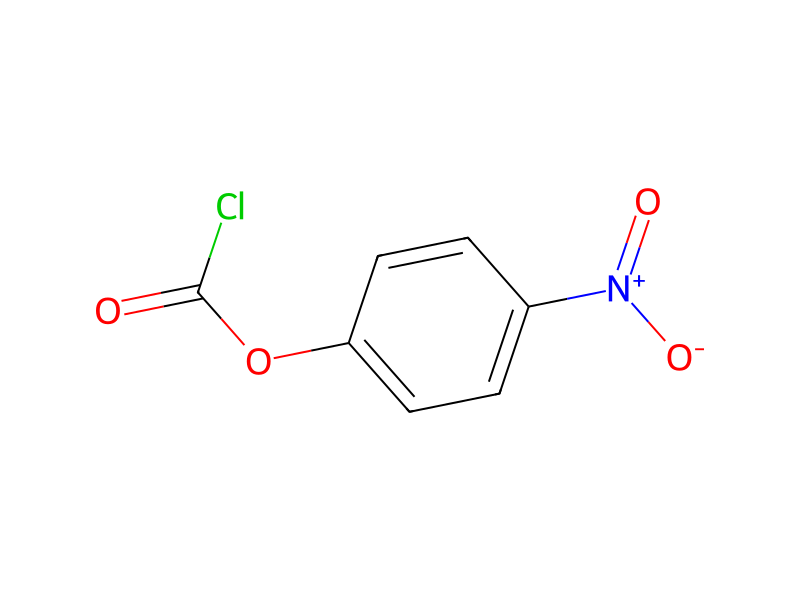
[OH:1][CH2:2][C:3]1[S:7][CH:6]=[N:5][CH:4]=1.CN1CCOCC1.Cl[C:16]([O:18][C:19]1[CH:24]=[CH:23][C:22]([N+:25]([O-:27])=[O:26])=[CH:21][CH:20]=1)=[O:17]>C(Cl)Cl.C(Cl)(Cl)Cl>[CH:23]1[C:22]([N+:25]([O-:27])=[O:26])=[CH:21][CH:20]=[C:19]([O:18][C:16]([O:1][CH2:2][C:3]2[S:7][CH:6]=[N:5][CH:4]=2)=[O:17])[CH:24]=1Participants
6





Procedure
A solution of 3.11 g (27 mmol) of 5-(hydroxymethyl)thiazole and excess N-methyl morpholine in 100 ml of methylene chloride was cooled to 0° C. (3 and treated with 8.2 g (41 mmol) of 4-nitrophenyl chloroformate. After being stirred for 1 h, the reaction mixture was diluted with CHCl3, washed successively with 1N HCl, saturated aqueous NaHCO3, and saturated brine, dried over NaSO4, and concentrated in vacuo. The residue was purified by silica gel chromatography (SiO2, 1-2% MeOH/CHCl3, Rf=0.5 in 4% MeOH/CHCl3) to yield 5.9 g (78%) of the desired compound as a yellow solid. NMR (CDCl3) δ5.53 (s, 2H), 7.39 (dt, J=9, 3 Hz, 2H), 8.01 (s, 1H), 8.29 (dt, J=9, 3 Hz, 2H), 8.90 (s, 1H), 8.01 (s, 1H). Mass spectrum: (M+H)+ =281.
Workup
- washwashed successively with 1N HCl, saturated aqueous NaHCO3, and saturated brine
- dry with materialdried over NaSO4
- concentrationconcentrated in vacuo
- customThe residue was purified by silica gel chromatography (SiO2, 1-2% MeOH/CHCl3, Rf=0.5 in 4% MeOH/CHCl3)
Sources & evidence
- ORD record
- ord-6546f6649eb447ddb42a16012373aad6
- Source dataset
- uspto-grants-1996_12
- Patent number
- US05583232
Reaction notes
Loading…