Hydrogen Peroxide → 3-(n-Decylsulfonyl)peroxypropionic acid
Reaction equation

C(SCCC#N)CCCCCCCCC.[CH2:16]([S:26]([CH2:29][CH2:30][C:31]([OH:33])=[O:32])(=[O:28])=[O:27])[CH2:17][CH2:18][CH2:19][CH2:20][CH2:21][CH2:22][CH2:23][CH2:24][CH3:25].[OH:34]O>CS(O)(=O)=O>[CH2:16]([S:26]([CH2:29][CH2:30][C:31]([O:33][OH:34])=[O:32])(=[O:27])=[O:28])[CH2:17][CH2:18][CH2:19][CH2:20][CH2:21][CH2:22][CH2:23][CH2:24][CH3:25]Participants


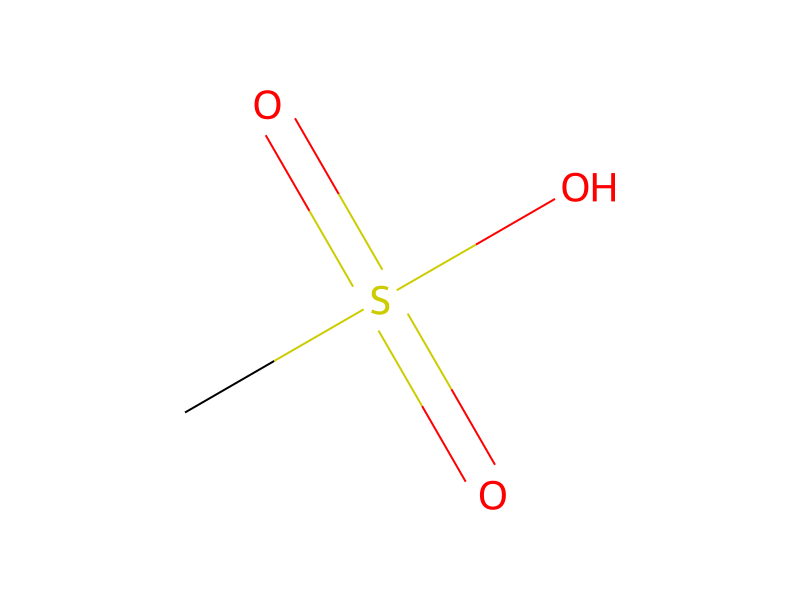
Conditions
- Temperature
- 10 °C
Procedure
The product of Example 9 was converted to the corresponding carboxylic acid by alkaline hydrolysis followed by acidification and then to the corresponding sulfone carboxylic acid by oxidation in accordance with a procedure found in U.S. Pat. No. 3,857,875 to Brady et al. A stirred mixture of 5 g of 3-(n-decylsulfonyl)propionic acid and 50 mL of methanesulfonic acid was heated to 40°±3° C. The 3-(n-decylsulfonyl)propionic acid dissolved only partially in the methanesulfonic acid at this temperature. Then 2.04 g of 90% hydrogen peroxide was added dropwise via pipette over ten minutes. Before the addition of the hydrogen peroxide was completed, the reaction mixture became thick from precipitation of a solid. After the addition of the 90% hydrogen peroxide was completed, the heating of the reaction mixture was continued at 40°±3° C. until the reaction time totalled ninety minutes beginning at the start of the addition of the hydrogen peroxide. The reaction mixture was then cooled in an ice bath at 10° C. The solid was then filtered from solution using a coarse sintered-glass funnel, then transferred to a beaker containing 200 mL of ice water prepared from deionized water. The product was washed twice with ice water, filtered and dried to provide 4.63 g of the desired product (87.6% of theoretical based upon the weight of starting 3-(n-decylsulfonyl)propionic acid). The product was found to have 5.32% active oxygen. The product was stabilized with an equal weight of boric acid and put through a #30 polyethylene sieve which provided a particle size of less than 600 microns. The stabilized product contained 2.58% by weight active oxygen.
Workup
- temperaturewas heated to 40°±3° C
- customthe reaction mixture became thick from precipitation of a solid
- additionAfter the addition of the 90% hydrogen peroxide
- temperaturethe heating of the reaction mixture
- customwas continued at 40°±3° C. until the reaction time
- waittotalled ninety minutes
- additionbeginning at the start of the addition of the hydrogen peroxide
- filtrationThe solid was then filtered from solution
- additioncontaining 200 mL of ice water
- customprepared from deionized water
- washThe product was washed twice with ice water
- filtrationfiltered
- customdried
Sources & evidence
- ORD record
- ord-2717169e83664aff91e1718e56bc1a6c
- Source dataset
- uspto-grants-1991_04
- Patent number
- US05004558
Reaction notes
Loading…