Chloroacetyl chloride → (-)-(1R,2S)-2-phenylcyclohexyl chloroacetate
Reaction equation

[C:1]1([C@@H:7]2[CH2:12][CH2:11][CH2:10][CH2:9][C@H:8]2[OH:13])[CH:6]=[CH:5][CH:4]=[CH:3][CH:2]=1.[Cl:14][CH2:15][C:16](Cl)=[O:17].C([O-])(O)=O.[Na+]>CN(C)C1C=CN=CC=1.C(Cl)Cl>[Cl:14][CH2:15][C:16]([O:13][C@@H:8]1[CH2:9][CH2:10][CH2:11][CH2:12][C@H:7]1[C:1]1[CH:6]=[CH:5][CH:4]=[CH:3][CH:2]=1)=[O:17]Participants
6





Procedure
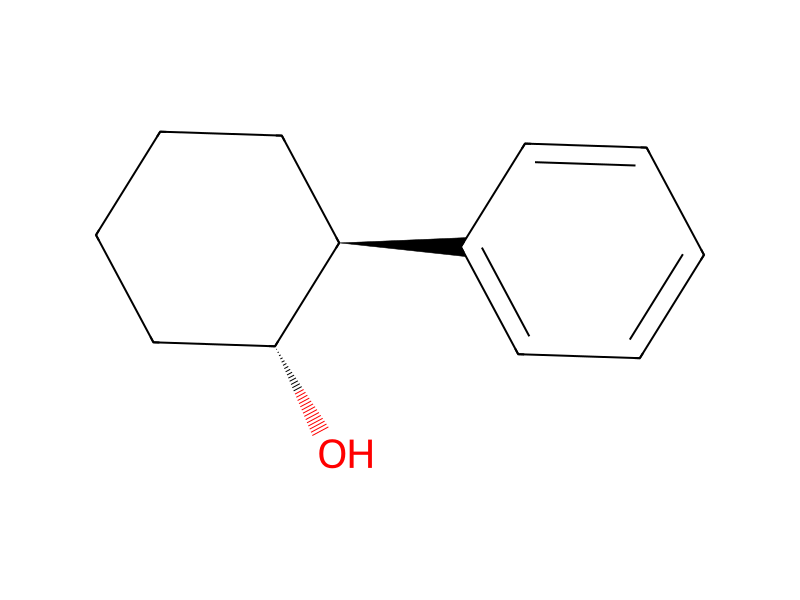
A mixture of 790 g (4.48 mole) of pure (-)-(1R,2S)-2-phenylcyclohexanol, 1.5 L of methylene chloride, 450 mL (5.625 mole) of chloroacetyl chloride, and 2.2 g (0.96 mole) of 4-dimethylaminopyridine was heated at reflux for 8 hours. On cooling, the reaction mixture was stirred with 2 ×1.5 L=3.0 L of saturated NaHCO3 for 30 minutes. The organic layer was dried (Na2SO4) and evaporated to dryness, finally at 0.5 mm for 4 hours to afford 1.136 kg of the title compound (100%) as an oil.
Workup
- temperaturewas heated
- temperatureat reflux for 8 hours
- temperatureOn cooling
- dry with materialThe organic layer was dried (Na2SO4)
- customevaporated to dryness, finally at 0.5 mm for 4 hours
Sources & evidence
- ORD record
- ord-94b7574d648e4646836c35bdadd147ee
- Source dataset
- uspto-grants-1991_04
- Patent number
- US05008411
Reaction notes
Loading…