Pyrazole → 3-(2-(1H-Pyrazol-1-yl)ethyl)-5-fluoro-1H-indole
Reaction equation

Br[CH2:2][CH2:3][C:4]1[C:12]2[C:7](=[CH:8][CH:9]=[C:10]([F:13])[CH:11]=2)[NH:6][CH:5]=1.[NH:14]1[CH:18]=[CH:17][CH:16]=[N:15]1.C(N(C(C)C)C(C)C)C>C(Cl)(Cl)Cl>[N:14]1([CH2:2][CH2:3][C:4]2[C:12]3[C:7](=[CH:8][CH:9]=[C:10]([F:13])[CH:11]=3)[NH:6][CH:5]=2)[CH:18]=[CH:17][CH:16]=[N:15]1Participants
5
Reactant 3
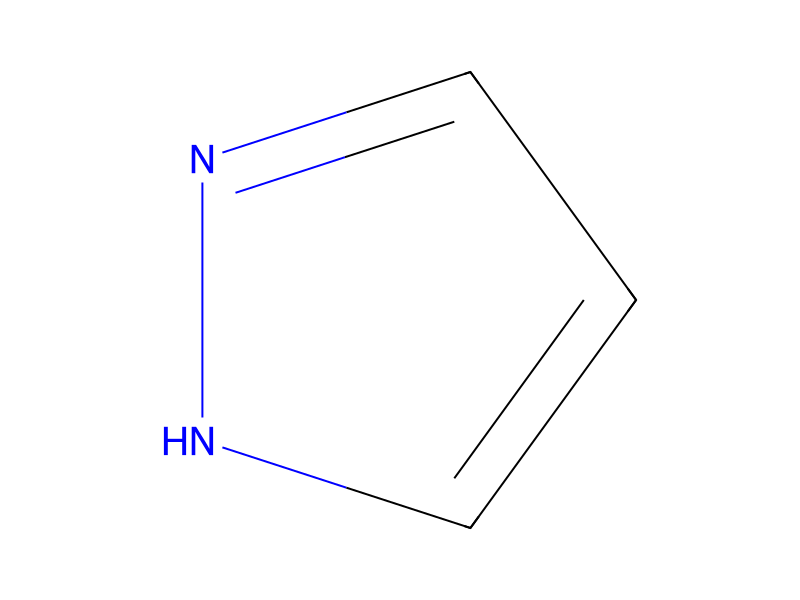


Product 1

Reagents, catalysts & solvents 1

Procedure
A solution of 3-(2-bromo-ethyl)-5-fluoro-1H-indole (7.26 g, 30 mmol), pyrazole (2.04 g, 30 mmol) and ethyl-diisopropylamine (5.1 ml, 30 mmol) in abs. chloroform (80 ml) was stirred at 90° C. for 12 h. The reaction solution was then washed twice with water, dried over Na2SO4 and concentrated i. vac. and the residue which remained was purified by flash chromatography with CHCl3/MeOH (20:1).
Workup
- washThe reaction solution was then washed twice with water
- dry with materialdried over Na2SO4
- concentrationconcentrated i
- customand the residue which remained was purified by flash chromatography with CHCl3/MeOH (20:1)
Sources & evidence
- ORD record
- ord-adbfa63c80a042baaa0acbdb07715642
- Source dataset
- uspto-grants-2012_03
- Patent number
- US08138187B2
Reaction notes
Loading…