4-Bromo-1,2-difluorobenzene → HCID 54337969, compound
Reaction equation

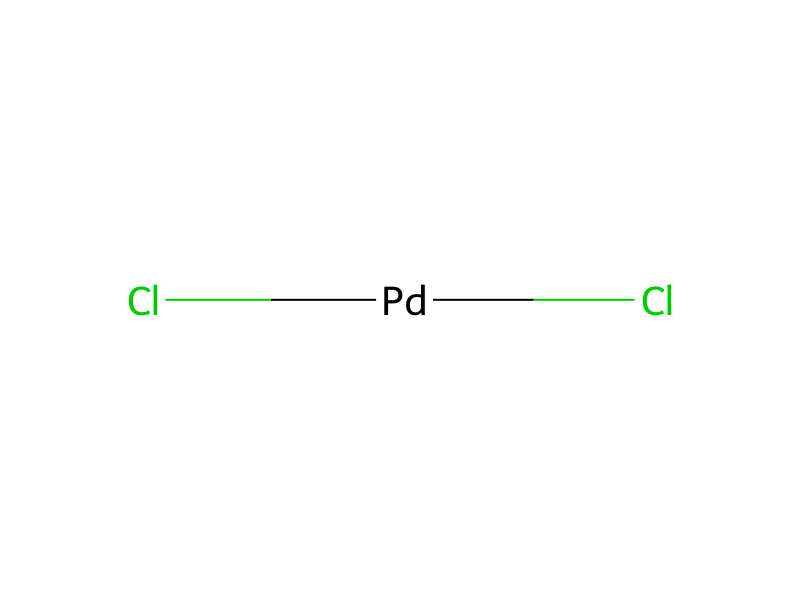
[Mg].Br[C:3]1[CH:8]=[CH:7][C:6]([F:9])=[C:5]([F:10])[CH:4]=1.I[C:12]1[CH:17]=[CH:16][C:15]([CH:18]2[O:22][CH2:21][CH2:20][O:19]2)=[CH:14][CH:13]=1.C1(P(C2C=CC=CC=2)(C2C=CC=CC=2)CCCP(C2C=CC=CC=2)(C2C=CC=CC=2)C2C=CC=CC=2)C=CC=CC=1>[Pd](Cl)Cl.O1CCCC1>[F:10][C:5]1[CH:4]=[C:3]([C:12]2[CH:17]=[CH:16][C:15]([CH:18]3[O:19][CH2:20][CH2:21][O:22]3)=[CH:14][CH:13]=2)[CH:8]=[CH:7][C:6]=1[F:9]Participants





Procedure
A Grignard reagent solution prepared from 1.0 g of magnesium, 7.6 g of 1-bromo-3,4-difluorobenzene and 75 ml of tetrahydrofuran was added dropwise to a mixture of 9.0 g of 2-(p-iodophenyl)dioxolane, 100 ml of tetrahydrofuran, 0.025 g of palladium(II) chloride and 0.16 g of 1,3-bis(triphenylphosphino)propane. The reaction mixture was heated to boiling for 3 days and, after cooling, extracted with 200 ml of diethyl ether and 120 ml of 0.5N ammonium chloride solution. The organic phase was washed with three 80 ml portions of water, dried over sodium sulphate and concentrated. Chromatographic purification of the residue on silica gel with hexane/ethyl acetate (vol. 9:1) gave pure 2-(3',4'-difluoro-4-biphenylyl)dioxolane; m.p. 89°-91° C.
Workup
- temperatureThe reaction mixture was heated
- temperatureafter cooling
- extractionextracted with 200 ml of diethyl ether and 120 ml of 0.5N ammonium chloride solution
- washThe organic phase was washed with three 80 ml portions of water
- dry with materialdried over sodium sulphate
- concentrationconcentrated
- customChromatographic purification of the residue on silica gel with hexane/ethyl acetate (vol. 9:1)
Sources & evidence
- ORD record
- ord-4b012a9c9d924672be387b3fff68f3c7
- Source dataset
- uspto-grants-1994_06
- Patent number
- US05322638
Reaction notes
Loading…