Diisopropylcarbodiimide → HCID 86738148, compound
Reaction equation

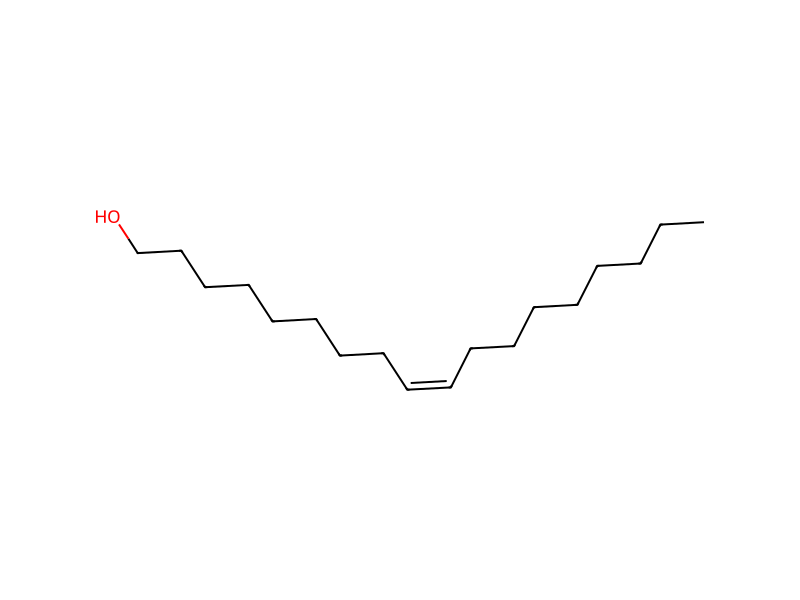
[CH:1]([N:4]=[C:5]=[N:6][CH:7]([CH3:9])[CH3:8])([CH3:3])[CH3:2].[CH2:10]([OH:28])[CH2:11][CH2:12][CH2:13][CH2:14][CH2:15][CH2:16][CH2:17]/[CH:18]=[CH:19]\[CH2:20][CH2:21][CH2:22][CH2:23][CH2:24][CH2:25][CH2:26][CH3:27]>>[CH2:10]([O:28][C:5](=[N:6][CH:7]([CH3:9])[CH3:8])[NH:4][CH:1]([CH3:3])[CH3:2])[CH2:11][CH2:12][CH2:13][CH2:14][CH2:15][CH2:16][CH2:17]/[CH:18]=[CH:19]\[CH2:20][CH2:21][CH2:22][CH2:23][CH2:24][CH2:25][CH2:26][CH3:27]Participants
3


Procedure
A mixture of N,N'-diisopropylcarbodiimide (12.6 g, 0.1 mole), oleyl alcohol (26.8 g, 0.1 mole) and cuprous chloride (60 mg) is stirred at room temperature for 4 hours. Infrared analysis shows the reaction to be virtually complete. The reaction mixture is placed on a column of alumina (454 g) and eluted with methylene chloride to give 36.2 g of O-oleyl-N,N'-diisopropylisourea. The product is identified by mass spectrometry (molecular ion at m/e 394), infrared spectroscopy (the C=N band at 1660 cm-1) and nuclear magnetic resonance in deuterated chloroform; resonances are given in δ relative to tetramethylsilane: 0.9-2.2 (multiplet 37 protons); 2.9-3.8 (multiplet 3 protons); 4.0 (triplet, 2 protons) 5.3 (multiplet, 2 protons).
Workup
- customthe reaction
- washeluted with methylene chloride
Sources & evidence
- ORD record
- ord-3c04c07e55484c6cae4df69e1631d5cb
- Source dataset
- uspto-grants-1984_12
- Patent number
- US04490303
Reaction notes
Loading…