1,3-Indandione → 2-(3,4-dichlorobenzylidene)-1H-indene-1,3(2H)-dione
Reaction equation

[C:1]1(=[O:11])[C:9]2[C:4](=[CH:5][CH:6]=[CH:7][CH:8]=2)[C:3](=[O:10])[CH2:2]1.[Cl:12][C:13]1[CH:14]=[C:15]([CH:18]=[CH:19][C:20]=1[Cl:21])[CH:16]=O>CCO.N1CCCCC1>[Cl:12][C:13]1[CH:14]=[C:15]([CH:18]=[CH:19][C:20]=1[Cl:21])[CH:16]=[C:2]1[C:1](=[O:11])[C:9]2[C:4](=[CH:5][CH:6]=[CH:7][CH:8]=2)[C:3]1=[O:10]Participants
5
Reactant 2

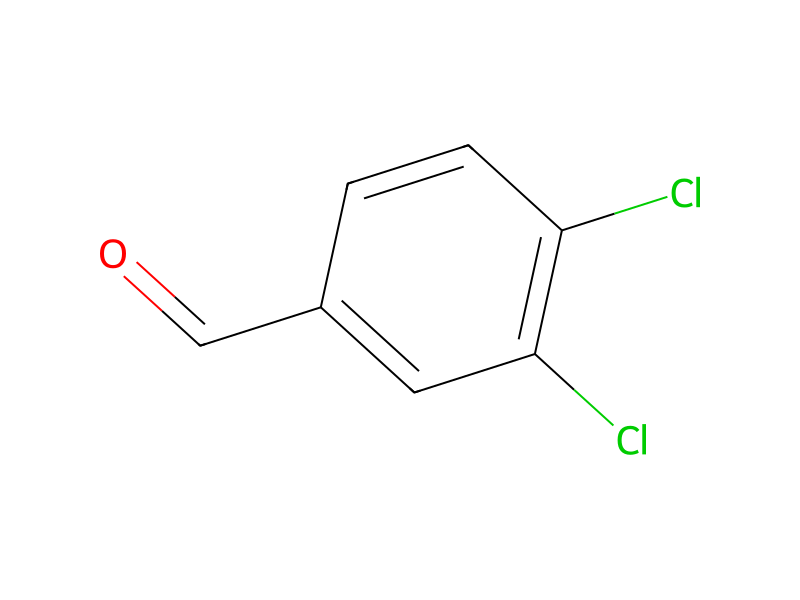
Product 1

Reagents, catalysts & solvents 2


Procedure
To a solution of indan-1,3-dione (1a) (960 mg, 6.6 mmol) in EtOH (8.2 mL) was added 3,4-dichlorobenzaldehyde (1b) (1.3 g, 7.2 mmol) followed by piperidine (3 drops). The reaction mixture was heated to reflux for 30 min. After cooling, the reaction was diluted with EtOH (8 mL) and the precipitate was filtered. The resulting solid was triturated twice with EtOH and dried under high vacuum to give 2-(3,4-dichloro-benzylidene)-indane-1,3-dione (1c) (1.7 g, 82% yield).
Workup
- temperatureThe reaction mixture was heated
- temperatureto reflux for 30 min
- temperatureAfter cooling
- filtrationthe precipitate was filtered
- customThe resulting solid was triturated twice with EtOH
- customdried under high vacuum
Sources & evidence
- ORD record
- ord-f5c44d939a1744719716c455bb899d0f
- Source dataset
- uspto-grants-2010_10
- Patent number
- US07807670B2
Reaction notes
Loading…