Isopropanol → HCID 59834466, compound
Reaction equation

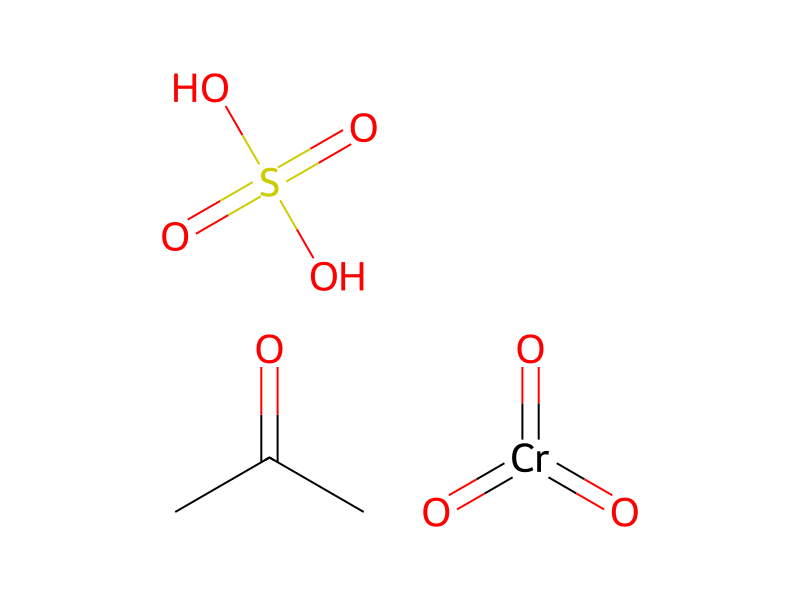
[Cl:1][C:2]1[CH:3]=[C:4]([CH2:20][CH2:21][OH:22])[CH:5]=[C:6]([Cl:19])[C:7]=1[S:8][C:9]1[N:10]=[N:11][C:12]([Cl:18])=[C:13]([CH:15]([CH3:17])[CH3:16])[CH:14]=1.CC(C)=[O:25].OS(O)(=O)=O.O=[Cr](=O)=O.CC(O)C>CC(C)=O.C(OCC)(=O)C.O>[Cl:19][C:6]1[CH:5]=[C:4]([CH2:20][C:21]([OH:25])=[O:22])[CH:3]=[C:2]([Cl:1])[C:7]=1[S:8][C:9]1[N:10]=[N:11][C:12]([Cl:18])=[C:13]([CH:15]([CH3:17])[CH3:16])[CH:14]=1Participants
Reactant 3


Product 1

Reagents, catalysts & solvents 3



Conditions
- Temperature
- 0 °C
Procedure
A solution of 2-[3,5-dichloro-4-(6-chloro-5-isopropyl-pyridazin-3-ylsulfanyl)-phenyl]-ethanol (74) (100 mg, 0.26 mmol) in acetone (2.0 mL) cooled to 0° C. was treated with a 2.7M solution of Jones reagent (0.21 mL, 0.57 mmol, prepared via standard method). The reaction was stirred at 0° C. for 1.25 h. At this time, the reaction was treated with 2-propanol until the red solution turned green. This mixture was then diluted with ethyl acetate (50 mL) and water (25 mL). The organics were separated, dried with magnesium sulfate, filtered, and concentrated under vacuum to afford [3,5-dichloro-4-(6-chloro-5-isopropyl-pyridazin-3-ylsulfanyl)-phenyl]-acetic acid (75) (92.5 mg, 89%) as an off-white foam. This material was used without further purification; LRMS-APCI for C15H13Cl3N2O2S (M+H)+ at m/z=390. Exact Mass=389.9763; Molecular weight=391.71
Workup
- customThe organics were separated
- dry with materialdried with magnesium sulfate
- filtrationfiltered
- concentrationconcentrated under vacuum
Sources & evidence
- ORD record
- ord-74bb0545dac341c58291aa316117a411
- Source dataset
- uspto-grants-2010_10
- Patent number
- US07807674B2
Reaction notes
Loading…