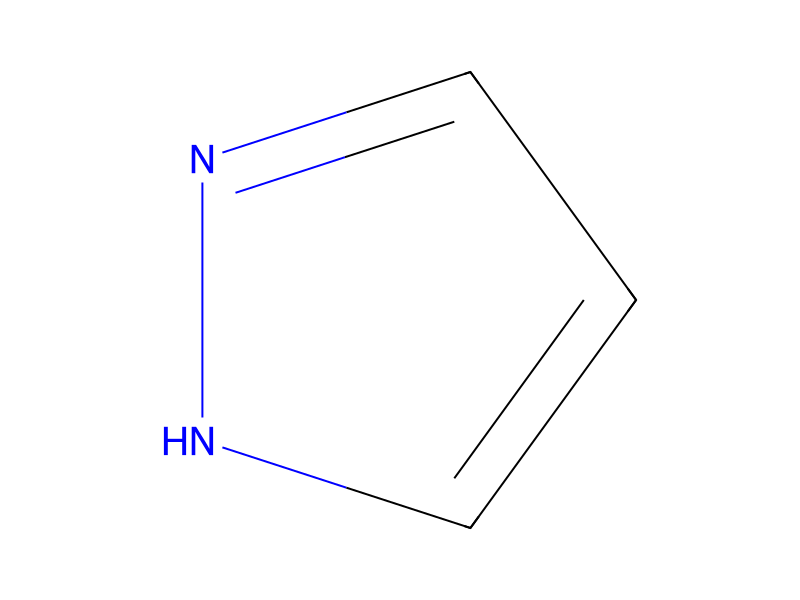
Pyrazole → 1-(4-(Benzyloxy)benzyl)-1H-pyrazole
Reaction equation

[NH:1]1[CH:5]=[CH:4][CH:3]=[N:2]1.[OH-].[K+].[CH2:8]([O:15][C:16]1[CH:21]=[CH:20][C:19]([CH2:22]Cl)=[CH:18][CH:17]=1)[C:9]1[CH:14]=[CH:13][CH:12]=[CH:11][CH:10]=1.C(OCC)(=O)C.CCCCCC>CN(C=O)C>[CH2:8]([O:15][C:16]1[CH:17]=[CH:18][C:19]([CH2:22][N:1]2[CH:5]=[CH:4][CH:3]=[N:2]2)=[CH:20][CH:21]=1)[C:9]1[CH:10]=[CH:11][CH:12]=[CH:13][CH:14]=1Participants
6
Reactant 4



Product 1

Reagents, catalysts & solvents 1

Procedure
After a mixture of pyrazole (7.73 mmol) and potassium hydroxide (7.73 mmol) in DMF (35 mL) was stirred at room temperature for 30 min., a solution of 1-(benzyloxy)-4-(chloromethyl)benzene (6.44 mmol) in DMF (7 mL) was added dropwise. The reaction mixture was stirred at room temperature overnight and the product obtained from a standard aqueous work up. Column chromatography (1:2 ethyl acetate/hexane) of the residue yielded compound 58.1 as a white solid. LC-MS ESI (pos.) m/e: 265 (M+H); 1H NMR (500 MHz) (DMSO-d6) δ 7.79 (1H, m); 7.46 (3H, m); 7.40 (2H, m); 7.36 (1H, m); 7.21 (2H, d, J=9 Hz)); 5.27 (2H, s); 5.11 (2H, m).
Workup
- stirringThe reaction mixture was stirred at room temperature overnight
- customthe product obtained from a standard aqueous work up
Sources & evidence
- ORD record
- ord-4c896c0439314c379361be8c547b1df7
- Source dataset
- uspto-grants-2010_10
- Patent number
- US07816367B2
Reaction notes
Loading…