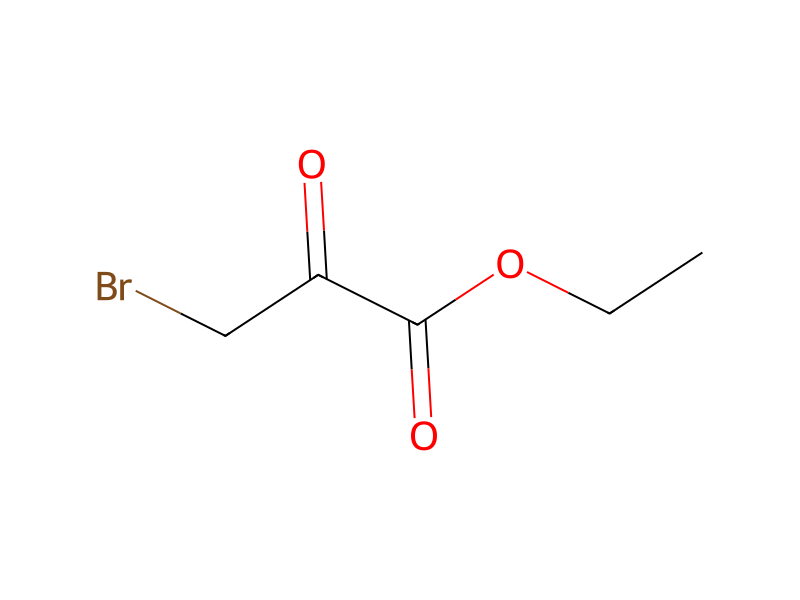
Ethyl bromopyruvate → HCID 11795549, compound
Reaction equation

[Cl:1][C:2]1[CH:7]=[CH:6][C:5]([C:8](=[NH:20])[NH:9][C:10]2[CH:15]=[CH:14][C:13]([S:16]([CH3:19])(=[O:18])=[O:17])=[CH:12][CH:11]=2)=[CH:4][CH:3]=1.C(=O)(O)[O-].[Na+].Br[CH2:27][C:28](=O)[C:29]([O:31][CH2:32][CH3:33])=[O:30]>CC(O)C>[Cl:1][C:2]1[CH:3]=[CH:4][C:5]([C:8]2[N:9]([C:10]3[CH:15]=[CH:14][C:13]([S:16]([CH3:19])(=[O:17])=[O:18])=[CH:12][CH:11]=3)[CH:27]=[C:28]([C:29]([O:31][CH2:32][CH3:33])=[O:30])[N:20]=2)=[CH:6][CH:7]=1Participants
Reactant 3


Product 1

Reagents, catalysts & solvents 1

Procedure
A mixture of 4-chloro-N-[4-(methylsulfonyl)phenyl]benzenecarboximidamide (Example 1, step 1) (12.1 g, 39.2 mmol), sodium bicarbonate (6.58 g, 78.3 mmol), and 90% ethyl bromopyruvate (16.9 g) in 480 ml of 2-propanol was stirred at reflux overnight. After cooling, the mixture was concentrated. The residue was partitioned between dichloromethane and water and the aqueous layer further extracted with dichloromethane. The combined organic extracts were dried over sodium sulfate, filtered, and evaporated. Trituration of the residue with ethyl acetate gave the title compound as a pale beige, crystalline solid (6.61 g): mp (DSC) 218° C. Anal. Calc'd. for C19H17ClN2O4S (MW 404.87): C, 56.37; H, 4.23; N, 6.92. Found: C, 56.28; H, 4.13; N, 6.80.
Workup
- temperatureat reflux overnight
- temperatureAfter cooling
- concentrationthe mixture was concentrated
- customThe residue was partitioned between dichloromethane and water
- extractionthe aqueous layer further extracted with dichloromethane
- dry with materialThe combined organic extracts were dried over sodium sulfate
- filtrationfiltered
- customevaporated
Sources & evidence
- ORD record
- ord-0e5c58f3764f4683867961bb2aceec38
- Source dataset
- uspto-grants-2003_09
- Patent number
- US06613789B2
Reaction notes
Loading…