Hydroquinone → 1,4-dioctyloxybenzene
Reaction equation

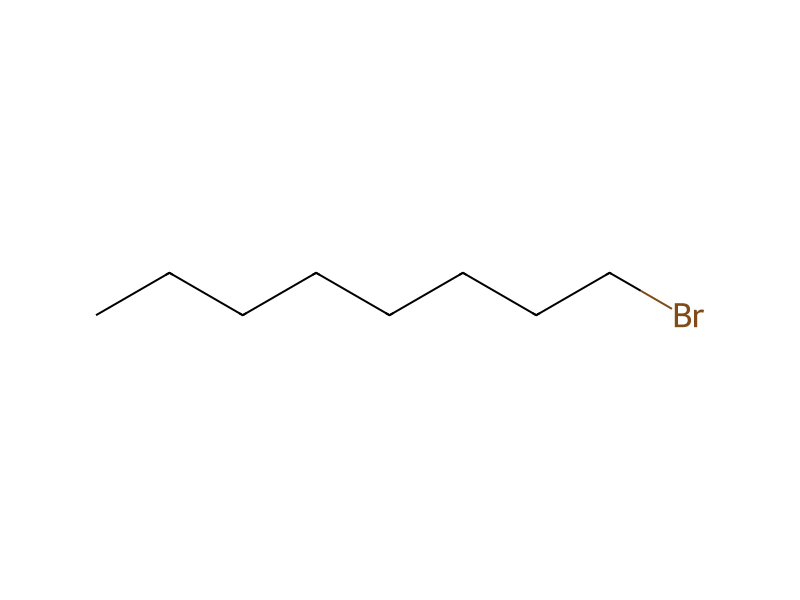
[C:1]1([CH:8]=[CH:7][C:5]([OH:6])=[CH:4][CH:3]=1)[OH:2].[OH-].[K+].Br[CH2:12][CH2:13][CH2:14][CH2:15][CH2:16][CH2:17][CH2:18][CH3:19].C(Cl)(Cl)Cl>C(O)C.O>[CH2:12]([O:2][C:1]1[CH:8]=[CH:7][C:5]([O:6][CH2:12][CH2:13][CH2:14][CH2:15][CH2:16][CH2:17][CH2:18][CH3:19])=[CH:4][CH:3]=1)[CH2:13][CH2:14][CH2:15][CH2:16][CH2:17][CH2:18][CH3:19]Participants
Reactant 4



Product 1

Reagents, catalysts & solvents 2


Procedure
Hydroquinone (10.00 g, 9.08×10⁻² mol) was dissolved in 100 ml of ethanol. After addition of KOH (10.79 g, 0.192 mol), the solution was stirred under reflux for 20 min. 1-Bromooctane (33.0 ml, 0.191 mol) was added dropwise to the light brown solution over 1 h, followed by stirring under reflux for 3 h. After cooling, CHCl3 and H2O were added to the reaction mixture and the organic layer was collected. The aqueous layer was further washed with CHCl3. The combined organic layers were washed with aqueous NaHCO3 and dried over Na2SO4. After the solvent was evaporated, the residue was chromatographed on silica gel with 1:1 hexane:CHCl3 as the eluent. Yield=27.33 g (90% based on 10.00 g of hydroquinone). 1H NMR (300 MHz, CDCl3): δ 6.82 (s, 4H, Ph-H), 3.90 (t, 4H, J=6.6 Hz, —OCH2—), 1.75 (quint, 4H, J=7.0 Hz, —OCCH2—), 1.37-1.51 (m, 4H, —OCCCH2), 1.17-1.37 (m, 16H, —CH2—), 1.20-1.49 (m, 24H, —CH2—), 0.88 (t, 6H, J=6.6 Hz, —CH3). CI MS m/z: 334.287 (M+) (calcd 334.287).
Workup
- temperatureunder reflux for 20 min
- stirringby stirring
- temperatureunder reflux for 3 h
- temperatureAfter cooling
- customthe organic layer was collected
- washThe aqueous layer was further washed with CHCl3
- washThe combined organic layers were washed with aqueous NaHCO3
- dry with materialdried over Na2SO4
- customAfter the solvent was evaporated
- customthe residue was chromatographed on silica gel with 1:1 hexane
Sources & evidence
- ORD record
- ord-e0b91d53f6e5491da2e82b242f6a8951
- Source dataset
- uspto-grants-2010_11
- Patent number
- US07842758B2
Reaction notes
Loading…