4-Hydroxypyrrolidine → 1-(Cyclopropylmethyl)pyrrolidin-3-ol
Reaction equation

[OH:1][CH:2]1[CH2:6][CH2:5][NH:4][CH2:3]1.[BH-](OC(C)=O)(OC(C)=O)OC(C)=O.[Na+].[CH2:21]1[CH:23]([CH:24](O)C#N)[CH2:22]1>CC(O)=O.C1COCC1.[OH-].[Na+]>[CH:23]1([CH2:24][N:4]2[CH2:5][CH2:6][CH:2]([OH:1])[CH2:3]2)[CH2:21][CH2:22]1Participants
7
Reactant 3
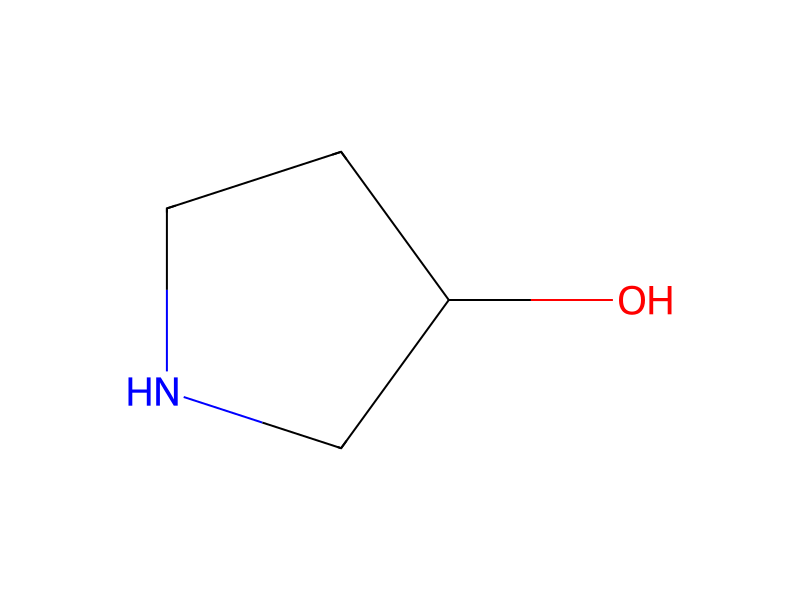


Product 1

Reagents, catalysts & solvents 3



Conditions
- Temperature
- 0 °C
Procedure
3-Hydroxy-pyrrolidine (5.65 g, 65 mmol, 1.0 equiv) was dissolved in 100 mL of 1% AcOH in THF and cooled to 0° C. Na(OAc)3BH (24 g, 114 mmol, 1.75 equiv) and cyclopropylcarboxaldehyde (5.0 g, 71 mmol, 1.1 equiv) were added and the resulting mixture was stirred at 0° C. for 1 h and room temperature overnight (16 h). The reaction was diluted with 200 mL of 2 N NaOH, and the product was extracted 3×200 mL of CH2Cl2. The organic extracts were combined, dried over Na2SO4, decanted and concentrated to yield the desired product as a free-flowing oil (7.26 g, 79%) which was used without further purification; MS, m/z 142=M+1.
Workup
- extractionthe product was extracted 3×200 mL of CH2Cl2
- dry with materialdried over Na2SO4
- customdecanted
- concentrationconcentrated
Sources & evidence
- ORD record
- ord-53433ae52e7c4067b2ccf3514da65ec6
- Source dataset
- uspto-grants-2007_10
- Patent number
- US07279472B2
Reaction notes
Loading…