p-Fluoronitrobenzene → 4-(2-(Pyrrolidin-1-yl)ethoxy)aniline
Reaction equation

[OH:1][CH2:2][CH2:3][N:4]1[CH2:8][CH2:7][CH2:6][CH2:5]1.[H-].[Na+].[N+:11]([C:14]1[CH:19]=[CH:18][C:17](F)=[CH:16][CH:15]=1)([O-])=O>C1COCC1>[N:4]1([CH2:3][CH2:2][O:1][C:17]2[CH:18]=[CH:19][C:14]([NH2:11])=[CH:15][CH:16]=2)[CH2:8][CH2:7][CH2:6][CH2:5]1Participants
Reactant 3
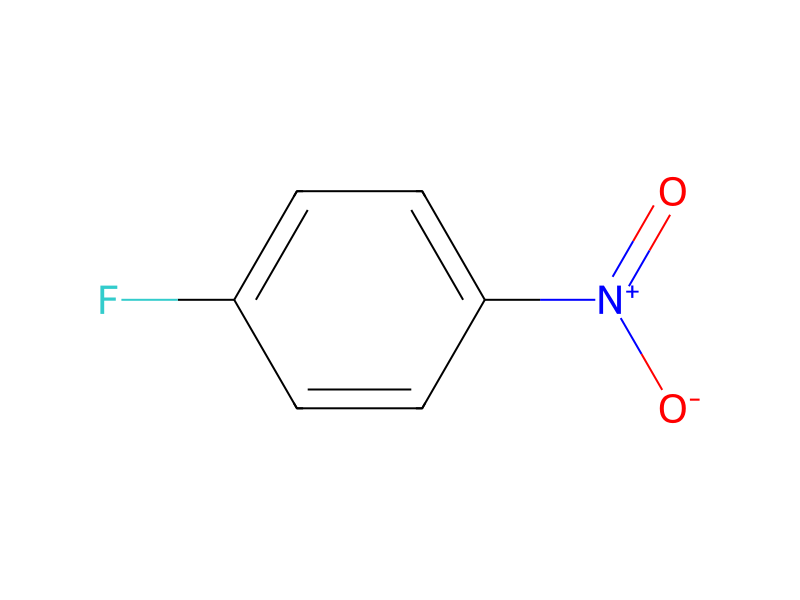


Product 1

Reagents, catalysts & solvents 1

Conditions
- Temperature
- 25 °C
Procedure
A solution of 1-(2-hydroxyethyl)pyrrolidine in THF was added dropwise to a slurry of NaH in THF under N2 at 25° C. over a 5 min period. The mixture was stirred at 25° C. for 30 min, during which time it turned to a dark amber solution. A solution of 4-nitrofluorobenzene in THF was added dropwise and the resultant mixture was stirred at 25° C. for 48 h. The dark brown solution was carefully quenched by the addition of saturated aqueous NaHCO3 and was diluted with EtOAc. The aqueous layer was extracted with EtOAc (3×) and the combined organic extracts were washed with saturated aqueous NaHCO3, brine (2×) and were dried over MgSO4 and concentrated in vacuo to give a pale amber oil that was used without further purification. A solution of 1-[2-(4-nitrophenoxy)ethyl]pyrrolidine in EtOH under N2 was treated with 10% Pd/C and placed under an atmosphere of H2 via Parr apparatus. The mixture was agitated for 3 h at ˜45 psi of hydrogen and was then purged with N2, and filtered through a plug of Celite (EtOAc/EtOH wash) under N2 to give a dark brown oil. Purification of the oil by flash chromatography (12 g pre-packed silica gel ISCO column, 0-15% CH3OH/CH2Cl2) afforded 4-(2-pyrrolidin-1-ylethoxy)aniline as a brown oil. A solution of Methyl 5-(4-chlorophenyl)-3-{[(E)-(dimethylamino)methylidene]amino}2-thiophenecarboxylate (Example J13) and aniline in EtOH under N2 was stirred and heated at reflux for 48 h. The mixture was filtered and the white solid was washed with EtOH and dried in vacuo. Purification by reverse phase chromatography (Gilson, 10-95% acetonitrile/water) and concentration via lyophilization afforded the desired product as a TFA salt. 1H NMR (DMSOd6) δ 9.80 (br s, 1H), 8.37 (s, 1H), 7.96 (s, 1H), 7.91 (d, J=8.8 Hz, 2H), 7.56 (d, J=8.8 Hz, 2H), 7.50 (d, J=9 Hz, 2H), 7.16 (d, J=9 Hz, 2H), 4.36 (m, 2H), 3.61 (m, 4H), 3.14 (m, 2H), 2.03 (m, 2H), 1.88 (m, 2H). LCMS m/z=452 (M++H).
Workup
- customThe dark brown solution was carefully quenched by the addition of saturated aqueous NaHCO3
- additionwas diluted with EtOAc
- extractionThe aqueous layer was extracted with EtOAc (3×)
- washthe combined organic extracts were washed with saturated aqueous NaHCO3, brine (2×)
- dry with materialwere dried over MgSO4
- concentrationconcentrated in vacuo
- customto give a pale amber oil that
- customwas used without further purification
- additionA solution of 1-[2-(4-nitrophenoxy)ethyl]pyrrolidine in EtOH under N2 was treated with 10% Pd/C
- stirringThe mixture was agitated for 3 h at ˜45 psi of hydrogen
- customwas then purged with N2
- filtrationfiltered through a plug of Celite (EtOAc/EtOH wash) under N2
- customto give a dark brown oil
- customPurification of the oil by flash chromatography (12 g pre-packed silica gel ISCO column, 0-15% CH3OH/CH2Cl2)
Sources & evidence
- ORD record
- ord-b931cb86a707483cb7a9c4f854d990d7
- Source dataset
- uspto-grants-2007_10
- Patent number
- US07285557B2
Reaction notes
Loading…