Hydrochloric Acid → HCID 22480374, compound
Reaction equation

[F:1][C:2]([F:14])([F:13])[C:3](=O)[CH2:4][C:5]([C:7]1[O:8][CH:9]=[CH:10][CH:11]=1)=O.Cl.Cl.Cl.[CH2:18]([NH:25][NH2:26])[C:19]1[CH:24]=[CH:23][CH:22]=[CH:21][CH:20]=1.C([O-])(O)=O.[Na+]>C(O)C>[CH2:18]([N:25]1[C:5]([C:7]2[O:8][CH:9]=[CH:10][CH:11]=2)=[CH:4][C:3]([C:2]([F:14])([F:13])[F:1])=[N:26]1)[C:19]1[CH:24]=[CH:23][CH:22]=[CH:21][CH:20]=1Participants





Procedure
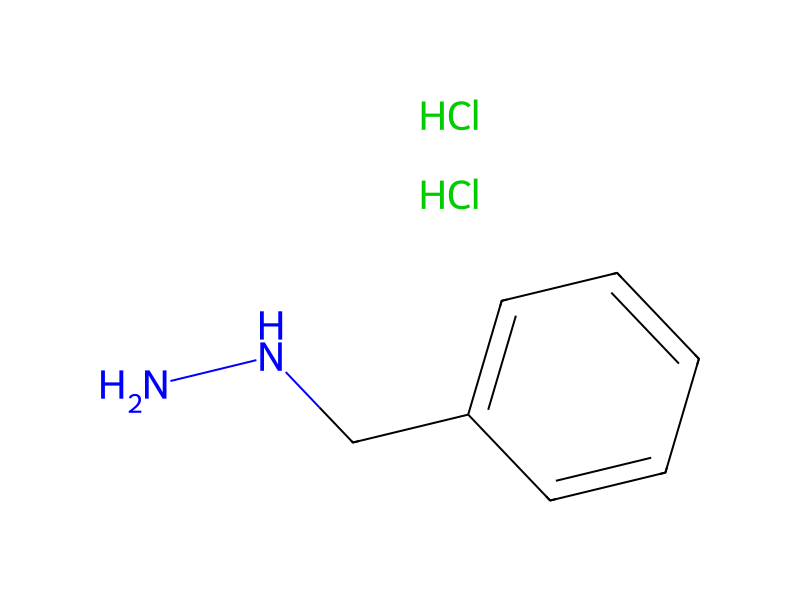
To a solution of 50 g (0.240 mol) 4,4,4-trifluoro-1-(2-furyl)-1,3-butanedione in 24 ml (0.024 mol) 1M solution of hydrogen chloride in ethanol and further 520 ml EtOH was added. 50 g (0.248 mol) benzylhydrazine dihydrochloride in small portion at room temperature. The reaction mixture was then heated under reflux for 7 h. After cooling to room temperature the reaction mixture was neutralized with saturated NaHCO3, the EtOH was distilled off and the residual oil/water mixture was extracted with 300 ml dichloromethane. The organic phase was washed twice with 100 ml water and dried over Na2SO4 and concentrated in vacuo to give 73.7 g 1-benzyl-5-furan-2-yl-3-trifluoromethyl-1H-pyrazole as a brown oil which was used crude for the next reaction.
Workup
- customat room temperature
- temperatureThe reaction mixture was then heated
- temperatureunder reflux for 7 h
- distillationthe EtOH was distilled off
- extractionthe residual oil/water mixture was extracted with 300 ml dichloromethane
- washThe organic phase was washed twice with 100 ml water
- dry with materialdried over Na2SO4
- concentrationconcentrated in vacuo
Sources & evidence
- ORD record
- ord-e02d8de21729451080a51b6c23d17456
- Source dataset
- uspto-grants-2007_10
- Patent number
- US07285569B2
Reaction notes
Loading…