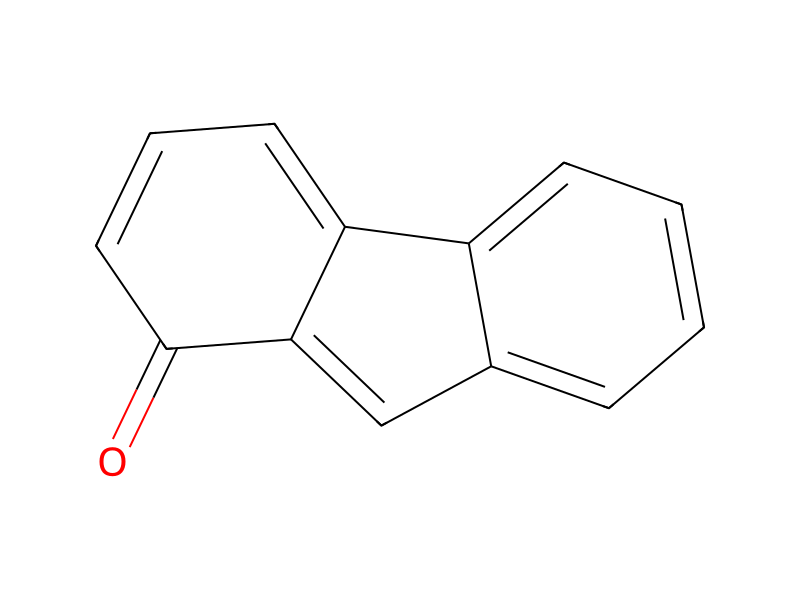
Oxygen → Fluoreneone
Reaction equation

[CH:1]1[C:13]2[CH2:12][C:11]3[C:6](=[CH:7][CH:8]=[CH:9][CH:10]=3)[C:5]=2[CH:4]=[CH:3][CH:2]=1.[OH:14]N1C(=O)C2=CC=CC=C2C1=O.O=O>C(O)(=O)C>[C:1]1(=[O:14])[C:13]2[C:5]([C:6]3[C:11]([CH:12]=2)=[CH:10][CH:9]=[CH:8][CH:7]=3)=[CH:4][CH:3]=[CH:2]1Participants
Reactant 3



Product 1
Reagents, catalysts & solvents 1

Procedure
A mixture containing 166 g (1 mol) of fluorene, 16 g (0.1 mol) of N-hydroxyphthalimide, and 1000 mL of acetic acid was allowed to react at 100° C. for 10 hours in an atmosphere of oxygen to obtain a reaction mixture containing 144 g of fluorenone (yield 80%). From the reaction mixture, acetic acid was distilled off, and to the reaction mixture were added 1000 mL of dibutyl ether and 1000 mL of 0.4N (0.4 mol/L) sodium hydroxide aqueous solution. After stirring at 97° C. for 1 hour, an aqueous phase and an organic phase were separated. To the resulting organic phase were further added sodium hydroxide aqueous solution, and mixed completely at 97° C. to liquid-separate to the aqueous phase and the organic phase. The resulting aqueous and organic phases were analyzed by gas chromatography and liquid chromatography, and, as a result, the extraction ratio of fluorenone into the organic phase was 98%, the extraction ratio of the oxidation catalyst and/or the deactivated oxidation catalyst (conversion into sodium phthalate) (on basis of the amount of N-hydroxyphthalimide used in the reaction) into the aqueous phase was 80%.
Workup
- customto obtain a reaction mixture
Sources & evidence
- ORD record
- ord-1858610dabc84eb481d2e77ffe66d025
- Source dataset
- uspto-grants-2007_10
- Patent number
- US07285684B2
Reaction notes
Loading…