Triethylamine → 4-(5-Bromo-2-chloro-pyrimidin-4-ylsulfanyl)-butan-1-ol
Reaction equation

[Br:1][C:2]1[C:3](Cl)=[N:4][C:5]([Cl:8])=[N:6][CH:7]=1.C(N(CC)CC)C.[SH:17][CH2:18][CH2:19][CH2:20][CH2:21][OH:22]>C(#N)C>[Br:1][C:2]1[C:3]([S:17][CH2:18][CH2:19][CH2:20][CH2:21][OH:22])=[N:4][C:5]([Cl:8])=[N:6][CH:7]=1Participants
5
Reactant 3

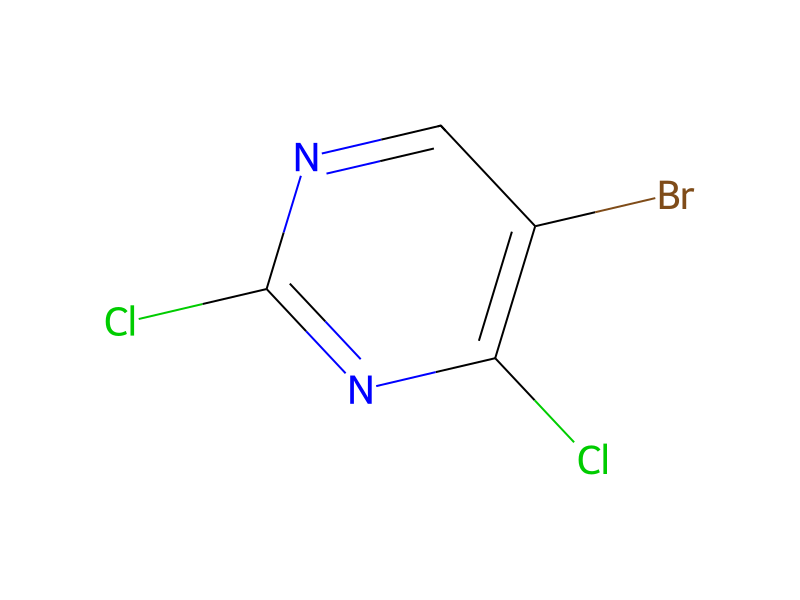

Product 1

Reagents, catalysts & solvents 1

Procedure
A solution of 2.27 g (10.0 mmol) of 5-bromo-2,4-dichloro-pyrimidine in 30 ml of acetonitrile is mixed while being stirred at −20° C. with 1.39 ml (10 mmol) of triethylamine. Then, a solution of 1.06 g (10 mmol) of 4-mercapto-1-butanol in 1 ml of acetonitrile is added in drops. The reaction mixture is heated overnight to room temperature while being stirred. The batch is filtered, and the filtrate is evaporated to the dry state. The residue that is obtained is purified by chromatography (Flashmaster II, hexane/ethyl acetate 1:1). 2.89 g (9.7 mmol, 97% of theory) of the product 4-(5-bromo-2-chloro-pyrimidin-4-ylsulfanyl)-butan-1-ol is obtained.
Workup
- temperatureThe reaction mixture is heated overnight to room temperature
- filtrationThe batch is filtered
- customthe filtrate is evaporated to the dry state
- customThe residue that is obtained
- customis purified by chromatography (Flashmaster II, hexane/ethyl acetate 1:1)
Sources & evidence
- ORD record
- ord-15557f5702e0467eabb7de0356413252
- Source dataset
- uspto-grants-2007_10
- Patent number
- US07288547B2
Reaction notes
Loading…