Diisopropylethylamine → HCID 67539976, compound
Reaction equation

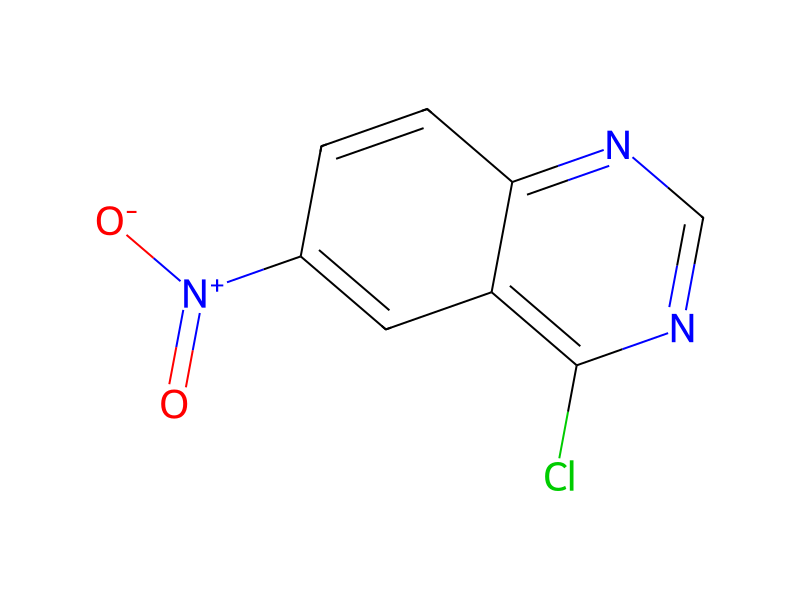
Cl[C:2]1[C:11]2[C:6](=[CH:7][CH:8]=[C:9]([N+:12]([O-:14])=[O:13])[CH:10]=2)[N:5]=[CH:4][N:3]=1.CCN(C(C)C)C(C)C.[C:24]([N:31]1[CH2:36][CH2:35][NH:34][CH2:33][CH2:32]1)([O:26][C:27]([CH3:30])([CH3:29])[CH3:28])=[O:25]>CC(O)C>[N+:12]([C:9]1[CH:10]=[C:11]2[C:6](=[CH:7][CH:8]=1)[N:5]=[CH:4][N:3]=[C:2]2[N:34]1[CH2:33][CH2:32][N:31]([C:24]([O:26][C:27]([CH3:30])([CH3:29])[CH3:28])=[O:25])[CH2:36][CH2:35]1)([O-:14])=[O:13]Participants
Reactant 3


Product 1

Reagents, catalysts & solvents 1

Conditions
- Temperature
- 60 °C
Procedure
To a solution of 4-chloro-6-nitroquinazoline (prepared according to the literature: Alexander J. Bridges et al. J. Med. Chem. 1996, 39, 267-276, and references therein; 12 g, 57.5 mmol) and DIEA (10 mL, 57.5 mmol) in 230 mL IPA was added Boc-piperazine (10.7 g, 57.5 mmol). The reaction mixture was heated to 60° C. and stirred for 13 hours, after which it was cooled to room temperature and concentrated by rotary evaporation. The residue was dissolved in dichloromethane (DCM) and washed with 1N NaOH. The organic layer was dried (Na2SO4), filtered, and concentrated by rotary evaporation. The resulting oil was purified on silica gel (1:1 to 1:4 DCM:EtOAc gradient) to furnish 4-(6-nitro-quinazolin-4-yl)-1-Boc-piperazine as a pale yellow oil (18.3 g, 89%). LCMS (APCI+) m/z 360 [M+H]+. HPLC Rt 3.06 min.
Workup
- temperatureafter which it was cooled to room temperature
- concentrationconcentrated by rotary evaporation
- dissolutionThe residue was dissolved in dichloromethane (DCM)
- washwashed with 1N NaOH
- dry with materialThe organic layer was dried (Na2SO4)
- filtrationfiltered
- concentrationconcentrated by rotary evaporation
- customThe resulting oil was purified on silica gel (1:1 to 1:4 DCM:EtOAc gradient)
Sources & evidence
- ORD record
- ord-e76225abe0414930b0f6920b8d5ed5fd
- Source dataset
- uspto-grants-2014_03
- Patent number
- US08680114B2
Reaction notes
Loading…