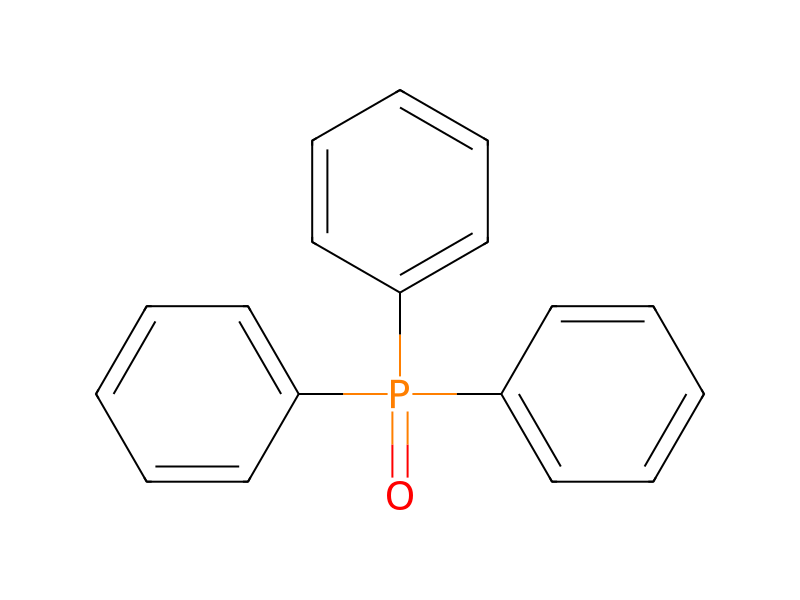
Imidazole → Triphenylphosphine Oxide
Reaction equation

BrBr.[OH:3]CCC1CC2C(C)=C(OCC3C=CC=CC=3)C(C)=C(C)C=2O1.[C:26]1([P:32]([C:39]2[CH:44]=[CH:43][CH:42]=[CH:41][CH:40]=2)[C:33]2[CH:38]=[CH:37][CH:36]=[CH:35][CH:34]=2)[CH:31]=[CH:30][CH:29]=[CH:28][CH:27]=1.N1C=CN=C1>C1(C)C=CC=CC=1>[C:39]1([P:32](=[O:3])([C:26]2[CH:27]=[CH:28][CH:29]=[CH:30][CH:31]=2)[C:33]2[CH:38]=[CH:37][CH:36]=[CH:35][CH:34]=2)[CH:40]=[CH:41][CH:42]=[CH:43][CH:44]=1Participants
Reactant 4




Product 1
Reagents, catalysts & solvents 1

Procedure
A solution of 0.8 ml of bromine in 15 ml of toluene is added, dropwise, to a solution of 4.0 gr. of 2-(RS)-(2-hydroxyethyl)-2,3-dihydro-5-benzyloxy-4,6,7-trimethylbenzofurane, 5.1 g of triphenylphosphine and 1.3 gr of imidazol in 70 ml of toluene. The mixture is stirred at room temperature for 15 minutes, after which the imidazol*HBr is filtered out and the filtrate is evaporated. The residue is treated with ethylic ether to obtain a precipitate of triphenylphosphine oxide, which is filtered out. After the residue has been evaporated, the obtained 7.7 g of raw material is purified by means of the column chromatography (SiO2), which produces 4.0 g of a yellow solid. m.p. 66°-68° C.; IR(KBr): 1549 (νC--C), 1075 cm-1 (νC--O--C); 1H-NMR (CDCl3): δ7.4-7.1 (5H,m), 5.0-4.5 (1H,m), 4.6 (2H,s), 3.5 (2H,t), 3.3-2.6 (2H,m), 2.3-2.1 (2H,m), 2.05 (9H,s).
Workup
- filtrationafter which the imidazol*HBr is filtered out
- customthe filtrate is evaporated
- additionThe residue is treated with ethylic ether
Sources & evidence
- ORD record
- ord-6b1e467afcd34e2197e32b91791b3fb1
- Source dataset
- uspto-grants-1992_05
- Patent number
- US05114966
Reaction notes
Loading…