2,6-Dibromopyridine → 2-Bromo-6-(hex-1-yn-1-yl)pyridine
Reaction equation

Br[C:2]1[CH:7]=[CH:6][CH:5]=[C:4]([Br:8])[N:3]=1.[CH:9]#[C:10][CH2:11][CH2:12][CH2:13][CH3:14]>C(N(CC)CC)C>[Br:8][C:4]1[N:3]=[C:2]([C:9]#[C:10][CH2:11][CH2:12][CH2:13][CH3:14])[CH:7]=[CH:6][CH:5]=1Participants
4
Reactant 2
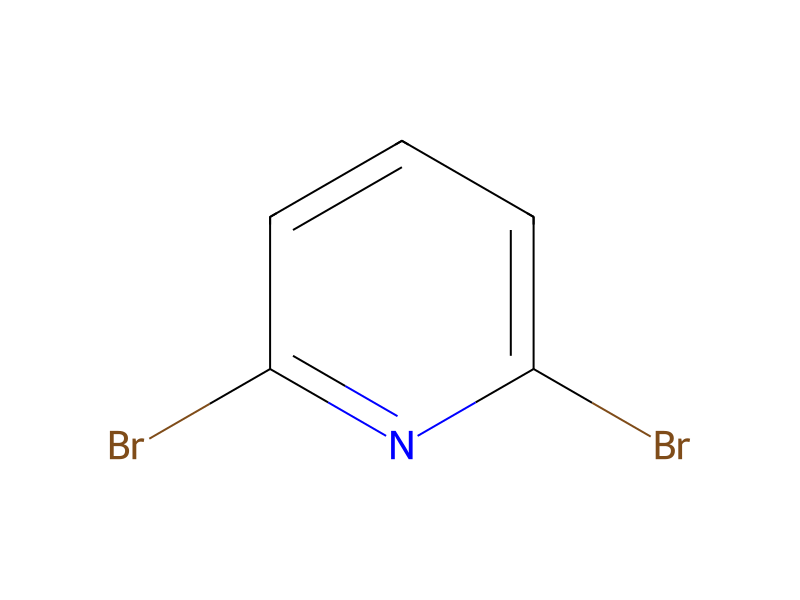

Product 1

Reagents, catalysts & solvents 1

Conditions
- Temperature
- 50 °C
Procedure
2,6-Dibromopyridine (2.36 g, 10 mmole) is suspended in 32 ml degassed triethylamine in a 100 ml one-neck round bottom flask under argon. The suspension is treated successively with (bis)triphenylphosphine palladium dichloride (62 mg, 0.08 mmole) and cuprous iodide (8 mg, 0.04 mmole) and is warmed to 50° C. 1-Hexyne (0.50 ml, 4.4 mmole), in 4 ml triethylamine, is added slowly dropwise to the reaction mixture over 30 minutes at 50° C. The reaction is stirred an additional one hour at 50° C., cooled to room temperature, and the triethylamine hydrobromide is removed by filtration. The filtrate is concentrated in vacuo to a white pasty solid.
Workup
- customdegassed triethylamine in a 100 ml one-neck round bottom flask under argon
- temperaturecooled to room temperature
- customthe triethylamine hydrobromide is removed by filtration
- concentrationThe filtrate is concentrated in vacuo to a white pasty solid
Sources & evidence
- ORD record
- ord-31758fc3336640e89312dc7e12f4cca8
- Source dataset
- uspto-grants-1992_05
- Patent number
- US05116981
Reaction notes
Loading…