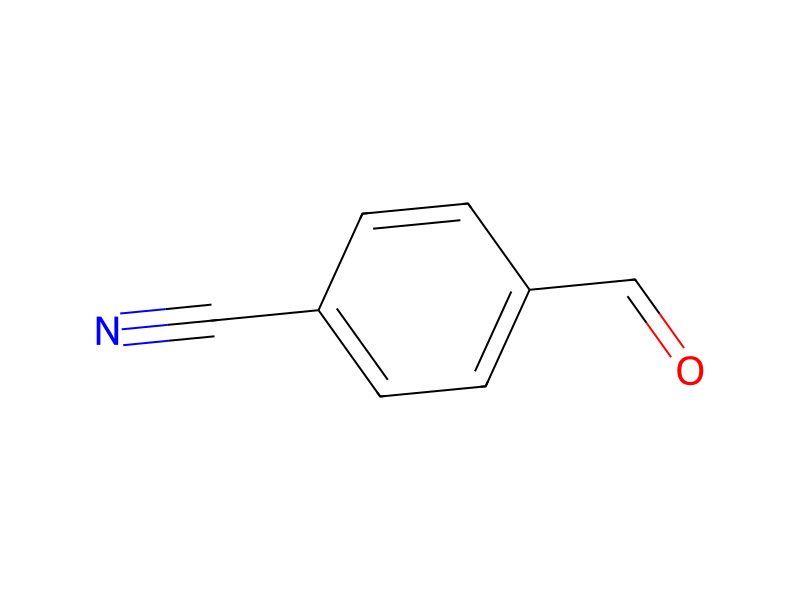
4-Cyanobenzaldehyde → HCID 19105707, compound
Reaction equation

C(OC(CO)CO)CCCCCCC.C(C1C=CC(C=O)=CC=1)#N.O.C1(C)C=CC(S(O)(=O)=O)=CC=1.[CH2:37]([O:45][CH2:46][CH:47]1[CH2:51][O:50][CH:49]([C:52]2[CH:59]=[CH:58][C:55]([C:56]#[N:57])=[CH:54][CH:53]=2)[O:48]1)[CH2:38][CH2:39][CH2:40][CH2:41][CH2:42][CH2:43][CH3:44]>C1C=CC=CC=1>[CH2:37]([O:45][CH:46]1[CH2:47][O:48][CH:49]([C:52]2[CH:53]=[CH:54][C:55]([C:56]#[N:57])=[CH:58][CH:59]=2)[O:50][CH2:51]1)[CH2:38][CH2:39][CH2:40][CH2:41][CH2:42][CH2:43][CH3:44]Participants
Reactant 4


Product 1

Reagents, catalysts & solvents 1

Procedure
To 10.2 g of the diol mixture obtained in (1) were added 100 ml of benzene, 6.6 g of p-cyanobenzaldehyde and p-toluenesulfonic acid monohydrate, and the mixture was heated. The generated water was removed by azeotropy with benzene. Then, the remaining benzene was distilled away, 200 ml of aqueous saturated sodium bicarbonate solution was added to the residue, and the mixture was extracted with dichloromethane. The extract was washed twice with water and dried over anhydrous sodium sulfate, and the solvent was distilled away to give 15.5 g of a crude product containing a by-product 4-(4-octyloxymethyl-1,3-dioxolan-2-yl)benzonitrile. This crude product was treated by column chromatography using silica gel to give 1.4 g of the desired product.
Workup
- temperaturethe mixture was heated
- customThe generated water was removed by azeotropy with benzene
- distillationThen, the remaining benzene was distilled away
- addition200 ml of aqueous saturated sodium bicarbonate solution was added to the residue
- extractionthe mixture was extracted with dichloromethane
- washThe extract was washed twice with water
- dry with materialdried over anhydrous sodium sulfate
- distillationthe solvent was distilled away
- customto give 15.5 g of a crude product
Sources & evidence
- ORD record
- ord-9d9269bff7aa4c2685e0a90aac2317df
- Source dataset
- uspto-grants-1994_01
- Patent number
- US05275757
Reaction notes
Loading…