Dimethylformamide dimethyl acetal → Ethyl 3-(dimethylamino)-2-isocyanoacrylate
Reaction equation

[N+:1]([CH2:3][C:4]([O:6][CH2:7][CH3:8])=[O:5])#[C-:2].CO[CH:11](OC)[N:12]([CH3:14])[CH3:13]>C(O)C>[CH2:7]([O:6][C:4](=[O:5])[C:3]([N+:1]#[C-:2])=[CH:11][N:12]([CH3:14])[CH3:13])[CH3:8]Participants
4
Reactant 2
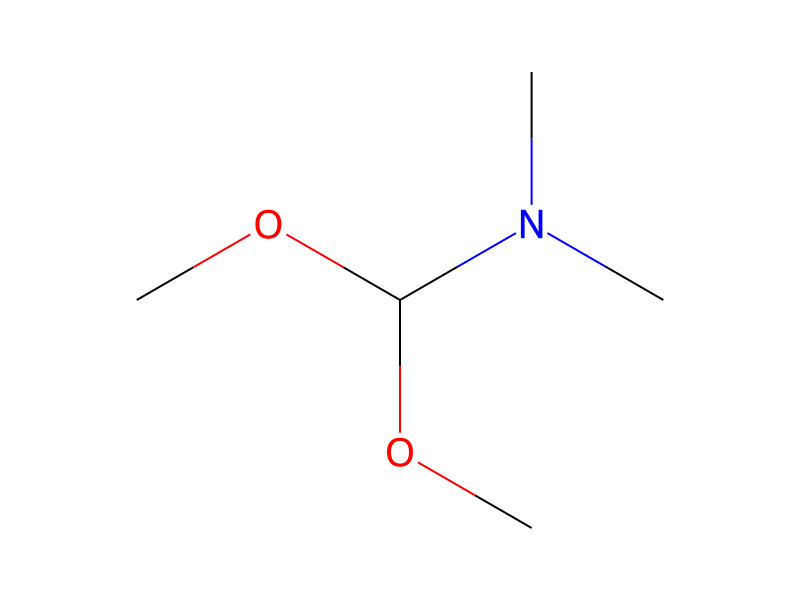

Product 1

Reagents, catalysts & solvents 1

Procedure
4-carboalkoxythiazoles are prepared essentially according to the procedure of Sch{umlaut over (of)}llkopf, U., Porsch, P., Lau, H. Liebigs Ann. Chem. 1444 (1979). Thus, according to Method 55 and 56, reaction of ethyl isocyanoacetate with N,N-dimethylformamide dimethyl acetal in a suitable alcoholic solvent such as ethanol at room temperature gives the corresponding 3-dimethylamino-2-isocyano-acrylic acid ethyl ester. A solution of this compound in a suitable solvent such as tetrahydrofuran is treated with gaseous hydrogen sulfide in the presence of a suitable tertiary amine base such as triethylamine or diiso-propylethylamine or the like at room temperature to give the corresponding 4-carboethoxy-thiazole.
Sources & evidence
- ORD record
- ord-b4f56fdda0414aa4b937bb6e3874551e
- Source dataset
- uspto-grants-2002_01
- Patent number
- US06335350B1
Reaction notes
Loading…