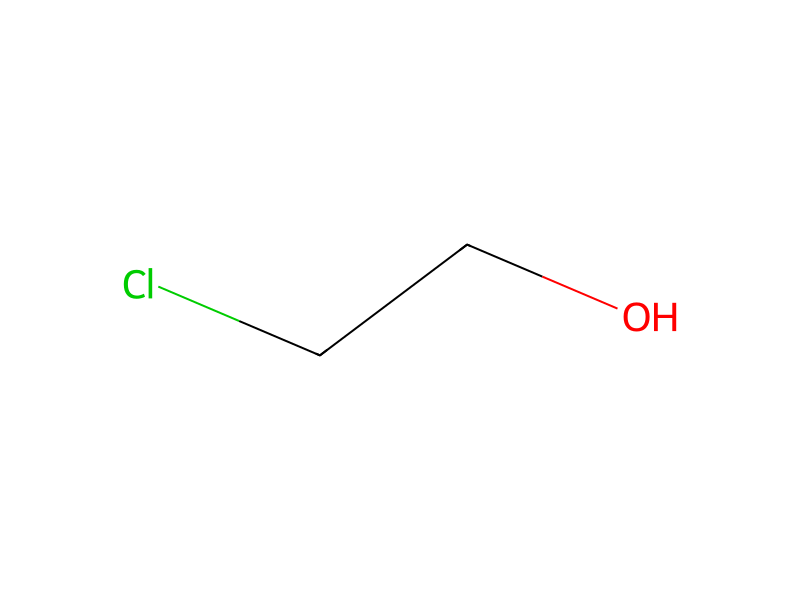
2-Chloroethanol → 5-(2-Chloroethoxy)quinoline
Reaction equation

[OH:1][C:2]1[CH:11]=[CH:10][CH:9]=[C:8]2[C:3]=1[CH:4]=[CH:5][CH:6]=[N:7]2.C1(P(C2C=CC=CC=2)C2C=CC=CC=2)C=CC=CC=1.[Cl:31][CH2:32][CH2:33]O.CCOC(/N=N/C(OCC)=O)=O>O1CCCC1.O>[Cl:31][CH2:32][CH2:33][O:1][C:2]1[CH:11]=[CH:10][CH:9]=[C:8]2[C:3]=1[CH:4]=[CH:5][CH:6]=[N:7]2Participants
7






Procedure
A 100 ml three-neck oven dry flask was cooled under nitrogen. 5-Hydroxy quinoline (2 g, 14 mmol) was added as well as triphenylphosphine (5.42 g, 21 mmol) suspended in 50 ml anhydrous tetrahydrofuran. 2-Chloroethanol (1.3 ml, 21 mmol) was slowly added to above reaction mixture via syringe, followed by adding DEAD (2.98 ml, 21 mmol) via syringe. A second 1.5 eq of 2-chloroethanol, triphenylphosphine and DEAD was added. The reaction mixture was poured into 100 ml water and extracted by methylene chloride. The organic layer was dried over anhydrous sodium sulfate and concentrated. Chromatographed (20% ethyl acetate-hexanes) afforded 2.31 g (82%) of product as a solid: mp 75-78° C.
Workup
- customA 100 ml three-neck oven dry flask
- temperaturewas cooled under nitrogen
- extractionextracted by methylene chloride
- dry with materialThe organic layer was dried over anhydrous sodium sulfate
- concentrationconcentrated
- customChromatographed (20% ethyl acetate-hexanes)
Sources & evidence
- ORD record
- ord-a38bd28523444c53953ac94759f3a5e2
- Source dataset
- uspto-grants-2002_01
- Patent number
- US06337336B1
Reaction notes
Loading…