Triethylamine → 2-Chloro-4-(trans-cinnamylamino)-7-methylthieno[3,2-d]pyrimidine
Reaction equation

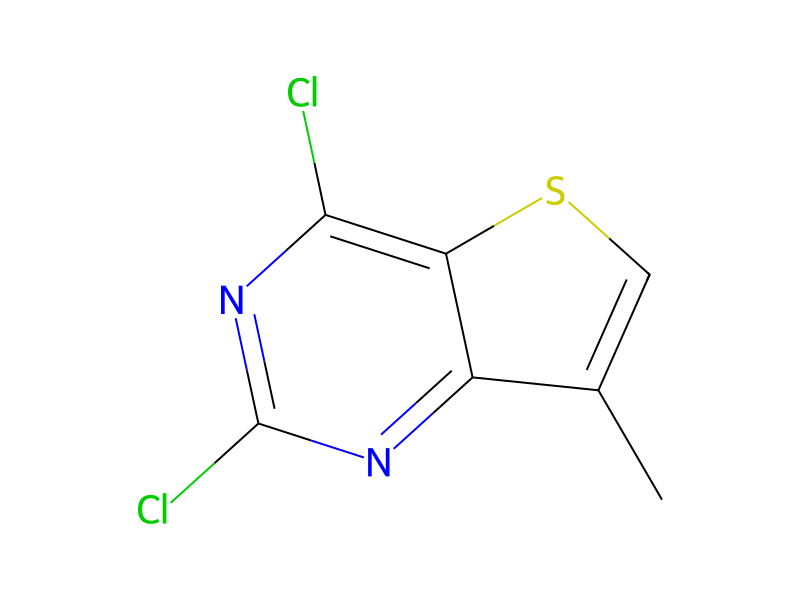
[Cl:1][C:2]1[N:3]=[C:4](Cl)[C:5]2[S:10][CH:9]=[C:8]([CH3:11])[C:6]=2[N:7]=1.C(N(CC)CC)C.Cl.[CH2:21]([NH2:30])/[CH:22]=[CH:23]/[C:24]1[CH:29]=[CH:28][CH:27]=[CH:26][CH:25]=1>CN(C=O)C>[Cl:1][C:2]1[N:3]=[C:4]([NH:30][CH2:21]/[CH:22]=[CH:23]/[C:24]2[CH:29]=[CH:28][CH:27]=[CH:26][CH:25]=2)[C:5]2[S:10][CH:9]=[C:8]([CH3:11])[C:6]=2[N:7]=1Participants




Procedure
To 10 ml of a solution of 438 mg (2.0 mmol) of 2,4-dichloro-7-metylthieno[3,2-d]pyrimidine and 445 mg (4.4 mmol) of triethylamine in DMF was added 339 mg (2.0 mmol) of trans-cinnamylamine hydrochloride under ice cooling. The reaction mixture was stirred at the same temperature for one hour and then allowed to resume room temperature, followed by stirring for further 2 hours. After completion of the reaction, ice water was added to the reaction mixture, followed by extraction with ethyl acetate (50 ml×3). After the organic layer was washed successively with 1N hydrochloric acid, water and brine and dried over anhydrous sodium sulfate, the solvent was distilled off under reduced pressure. The residue was purified by silica gel chromatography (eluent: ethyl acetate-hexane=1/4) to give 341 mg (yield: 54.0%) of the title compound.
Workup
- customto resume room temperature
- stirringby stirring for further 2 hours
- additionwas added to the reaction mixture
- extractionfollowed by extraction with ethyl acetate (50 ml×3)
- washAfter the organic layer was washed successively with 1N hydrochloric acid, water and brine
- dry with materialdried over anhydrous sodium sulfate
- distillationthe solvent was distilled off under reduced pressure
- customThe residue was purified by silica gel chromatography (eluent: ethyl acetate-hexane=1/4)
Sources & evidence
- ORD record
- ord-0647b7b1a30c4fd8b9cb64434c290bb1
- Source dataset
- uspto-grants-2002_01
- Patent number
- US06339089B2
Reaction notes
Loading…