Dimethylcarbamoyl Chloride → Triazamate
Reaction equation

[C:1]([C:5]1[N:9]=[C:8]([S:10][CH2:11][C:12]([O:14][CH2:15][CH3:16])=[O:13])[NH:7][N:6]=1)([CH3:4])([CH3:3])[CH3:2].[CH3:17][N:18]([CH3:22])[C:19](Cl)=[O:20]>CN(C)C1C=CN=CC=1.N1C=CC=CC=1>[CH3:17][N:18]([CH3:22])[C:19]([N:7]1[C:8]([S:10][CH2:11][C:12]([O:14][CH2:15][CH3:16])=[O:13])=[N:9][C:5]([C:1]([CH3:4])([CH3:2])[CH3:3])=[N:6]1)=[O:20]Participants
5
Reactant 2
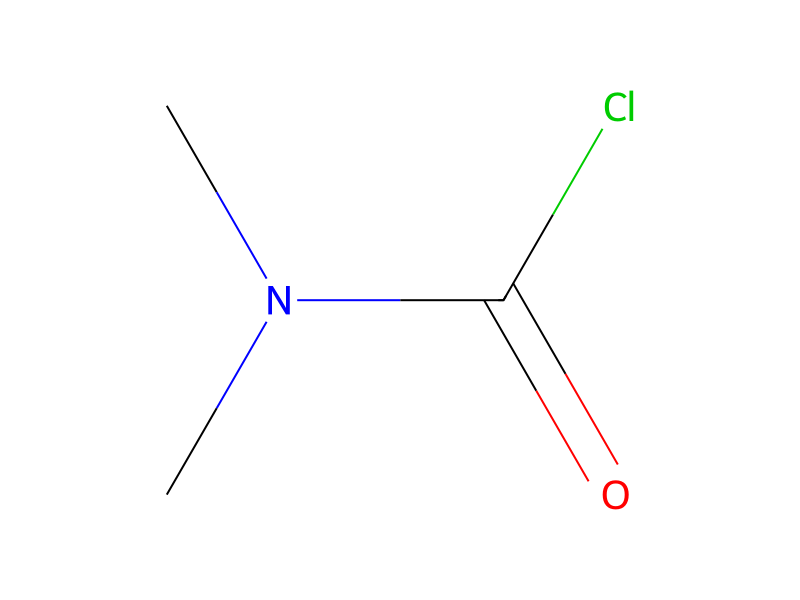

Product 1

Reagents, catalysts & solvents 2


Procedure
To 100 g (0.411 mole) of 3-t-butyl-5-carboethoxymethylthio-1H-1,2,4-triazole, 6 g (0.05 mole) of 4-dimethylaminopyridine, and 200 ml of pyridine was added 54 g (0.50 mole) of dimethylcarbamoyl chloride. The resulting solution was refluxed for eight hours and allowed to cool overnight. The reaction mixture was concentrated under vacuum, partitioned between ether and dilute hydrochloric acid. The organic layer was washed with water, brine, dried over magnesium sulfate, and concentrated under vacuum. Distillation yielded a fraction boiling at 148°-160° C. at 0.1 torr 100 g (0.35 mole) of 1-dimethylcarbamoyl-3-t-butyl-5-carboethoxymethylthio-1,2,4-triazole. m.p. 55° C.
Workup
- temperatureThe resulting solution was refluxed for eight hours
- temperatureto cool overnight
- concentrationThe reaction mixture was concentrated under vacuum
- custompartitioned between ether and dilute hydrochloric acid
- washThe organic layer was washed with water, brine
- dry with materialdried over magnesium sulfate
- concentrationconcentrated under vacuum
- distillationDistillation
Sources & evidence
- ORD record
- ord-05f517077a134234b9cf5ee2bf41b633
- Source dataset
- uspto-grants-1988_05
- Patent number
- US04742072
Reaction notes
Loading…