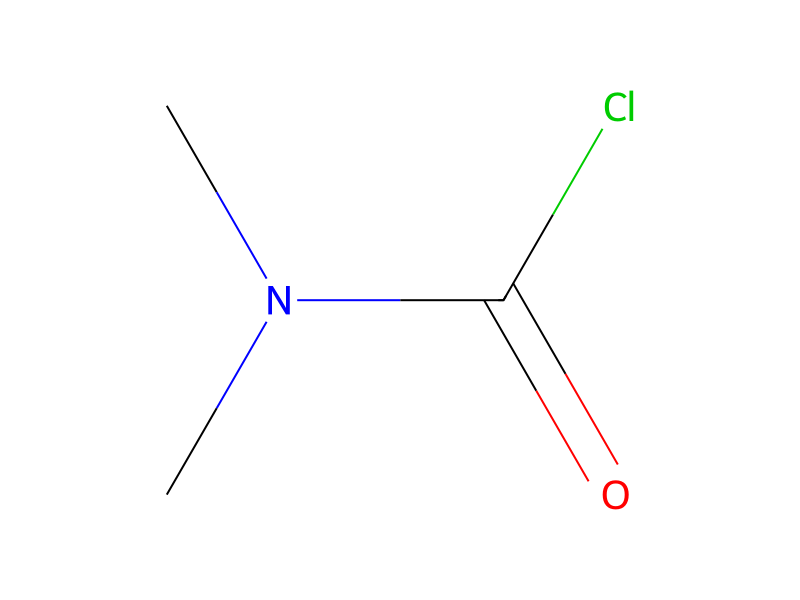
Dimethylcarbamoyl Chloride → Trans-3-(4-chlorophenoxy)-4-hydroxy-N,N-dimethyl-1-pyrrolidinecarboxamide
Reaction equation

[Cl:1][C:2]1[CH:14]=[CH:13][C:5]([O:6][CH:7]2[CH2:11][NH:10][CH2:9][CH:8]2[OH:12])=[CH:4][CH:3]=1.[CH3:15][N:16]([CH3:20])[C:17](Cl)=[O:18].C(N(CC)CC)C>C(Cl)Cl>[Cl:1][C:2]1[CH:14]=[CH:13][C:5]([O:6][C@H:7]2[C@H:8]([OH:12])[CH2:9][N:10]([C:17]([N:16]([CH3:20])[CH3:15])=[O:18])[CH2:11]2)=[CH:4][CH:3]=1Participants
5




Procedure
A solution of 3.5 g. of 4-(4-chlorophenoxy)-3-pyrrolidinol, 1.8 g. of dimethylcarbamyl chloride and 1.7 g. of triethylamine in 300 ml of methylene chloride was stirred for 60 hr. The solvent was removed under vacuum, 300 ml of benzene was added and the mixture was refluxed for 2 hr., then filtered. After solvent evaporation, the residue was dissolved in cyclohexane-benzene and charcoaled. The product was then crystallized, collected by filtration and recrystallized from cyclohexane-benzene; m.p. 137°-142° C. Analysis: Calculated for C13H17N2O3Cl: C, 54.84; H, 6.02; N, 9.84. Found: C, 54.64; H, 6.01; N, 9.77.
Workup
- customThe solvent was removed under vacuum, 300 ml of benzene
- additionwas added
- temperaturethe mixture was refluxed for 2 hr
- filtration, then filtered
- customAfter solvent evaporation
- dissolutionthe residue was dissolved in cyclohexane-benzene
- customThe product was then crystallized
- filtrationcollected by filtration
- customrecrystallized from cyclohexane-benzene
Sources & evidence
- ORD record
- ord-70d73af2ba094f05a6c2b0e7f6c19f4e
- Source dataset
- uspto-grants-1984_06
- Patent number
- US04452809
Reaction notes
Loading…