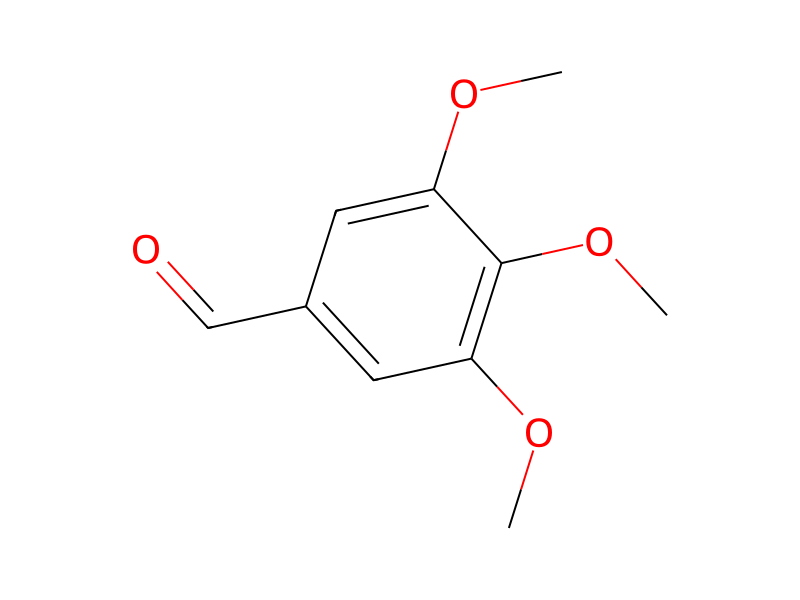
Syringaldehyde → 3,4,5-Trimethoxybenzaldehyde
Reaction equation

[CH:1](=[O:13])[C:2]1[CH:12]=[C:9]([O:10][CH3:11])[C:7]([OH:8])=[C:4]([O:5][CH3:6])[CH:3]=1.[C:14](=O)([O-])[O-].[K+].[K+].S(OC)(OC)=O>>[CH3:11][O:10][C:9]1[CH:12]=[C:2]([CH:3]=[C:4]([O:5][CH3:6])[C:7]=1[O:8][CH3:14])[CH:1]=[O:13]Participants
4



Conditions
- Temperature
- 100 °C
Procedure
In a three-neck flask (capacity 100 ml) equipped with a mechanical stirrer and reflux condenser, 10.0 g (0.054 mol) of syringaldehyde and 5.00 g (0.036 mol) of anhydrous potassium carbonate were placed and the mixture was heated under a nitrogen atmosphere to 100° C. To this mixture was added 8.00 ml (0.094 mol) of dimethyl sulfite over about 5 minutes while maintaining the reaction temperature below 125° C. The pasty mixture was maintained at about 100° C. for three hours and then cooled to 25° C. and quenched with 50 ml water. The mixture was extracted with 100 ml of methylene chloride. The extracts were washed with water and concentrated in vacuo to give 4.2 g of 3, 4, 5-trimethoxybenzaldehyde.
Workup
- customIn a three-neck flask (capacity 100 ml) equipped with a mechanical stirrer
- temperaturereflux condenser
- temperaturewhile maintaining the reaction temperature below 125° C
- temperatureThe pasty mixture was maintained at about 100° C. for three hours
- temperaturecooled to 25° C.
- customquenched with 50 ml water
- extractionThe mixture was extracted with 100 ml of methylene chloride
- washThe extracts were washed with water
- concentrationconcentrated in vacuo
Sources & evidence
- ORD record
- ord-30515f79dd7a41eeb33e02c368416f84
- Source dataset
- uspto-grants-1984_06
- Patent number
- US04453018
Reaction notes
Loading…