Triphenylphosphine → HCID 18546016, compound
Reaction equation

[CH3:1][C:2]1[CH:7]=[CH:6][C:5]([S:8]([O:11][CH2:12][C@@H:13]2[O:18][C:17]3[C:19]([CH2:31][CH2:32][OH:33])=[C:20](OCC4C=CC=CC=4)[CH:21]=[CH:22][C:16]=3[O:15][CH2:14]2)(=[O:10])=[O:9])=[CH:4][CH:3]=1.[H][H].C1(P(C2C=CC=CC=2)C2C=CC=CC=2)C=CC=CC=1.CC(OC(/N=N/C(OC(C)C)=O)=O)C>CO.[Pd]>[CH3:1][C:2]1[CH:3]=[CH:4][C:5]([S:8]([O:11][CH2:12][CH:13]2[CH2:14][O:15][C:16]3[CH:22]=[CH:21][C:20]4[O:33][CH2:32][CH2:31][C:19]=4[C:17]=3[O:18]2)(=[O:10])=[O:9])=[CH:6][CH:7]=1Participants
Reactant 4



Product 1

Reagents, catalysts & solvents 2


Procedure
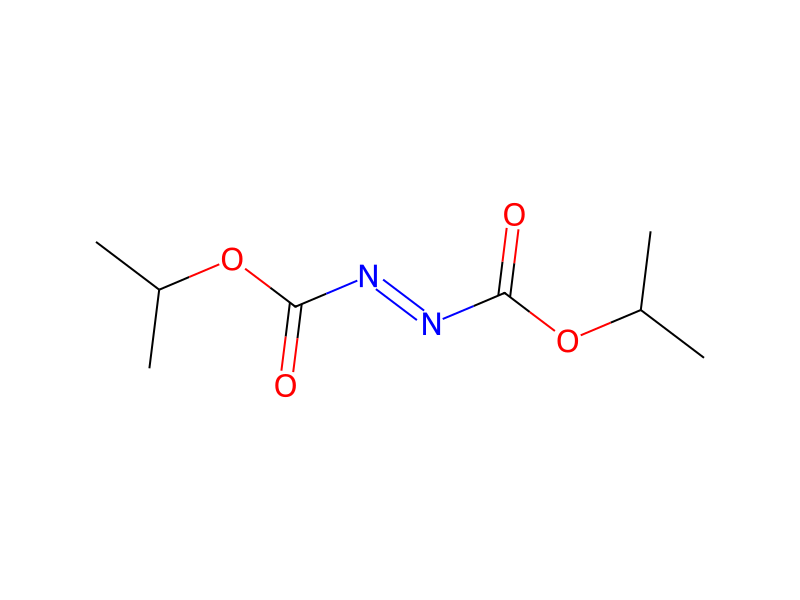
A solution of 2.3 g (4.9 mmole) of [(2R)-7-(benzyloxy)-8-(2-hydroxyethyl)-2,3-dihydro-1,4-benzodioxin-2-yl]methyl 4-methylbenzenesulfonate in 100 mL of methanol was added to a slurry of 0.40 g of 10% palladium on carbon in 30 mL of methanol in 500 mL Parr hydrogenation bottle. The mixture was treated with 50 psi of hydrogen on a Parr shaker for 15 hours. The catalyst was then removed by filtration through celite and the filtrate concentrated in vacuum to 1.72 g of a yellow oil. The oil was dissolved in 100 mL of benzene, 2.1 g (8.0 mmole) of triphenylphosphine and 1.6 g (8.0 mmole) of diisopropylazodicarboxylate added and the mixture stirred at room temperature for 3 days. The solvent was then removed in vacuum and the residue column chromatographed on silica gel with methylene chloride as eluant to give 1.25 g of the (R)-enantiomer of the title compound as a white solid, m.p. 95-96° C.
Workup
- customThe catalyst was then removed by filtration through celite
- concentrationthe filtrate concentrated in vacuum to 1.72 g of a yellow oil
- dissolutionThe oil was dissolved in 100 mL of benzene
- customThe solvent was then removed in vacuum
- customthe residue column chromatographed on silica gel with methylene chloride as eluant
Sources & evidence
- ORD record
- ord-0209cbf9415f452b94dfb4e106a92cda
- Source dataset
- uspto-grants-2003_04
- Patent number
- US06552049B2
Reaction notes
Loading…