Water → 5-((4-methylpentyl)oxy)-1H-indazole
Reaction equation

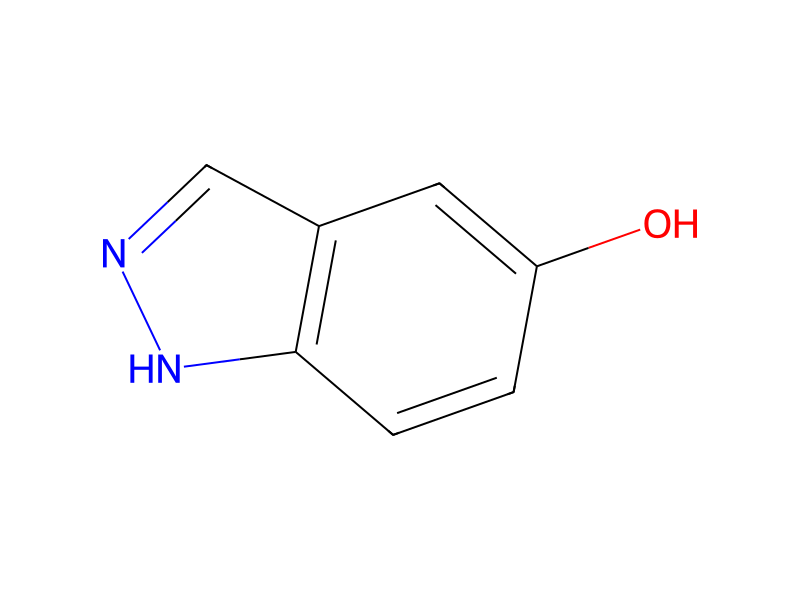
[NH:1]1[C:9]2[C:4](=[CH:5][C:6]([OH:10])=[CH:7][CH:8]=2)[CH:3]=[N:2]1.Br[CH2:12][CH2:13][CH2:14][CH:15]([CH3:17])[CH3:16].C(=O)([O-])[O-].[K+].[K+].O>CN(C)C=O.[I-].C([N+](CCCC)(CCCC)CCCC)CCC>[CH3:16][CH:15]([CH3:17])[CH2:14][CH2:13][CH2:12][O:10][C:6]1[CH:5]=[C:4]2[C:9](=[CH:8][CH:7]=1)[NH:1][N:2]=[CH:3]2Participants
7






Conditions
- Temperature
- 60 °C
Procedure
To a solution of the 1H-indazol-5-ol (100 mg, 0.745 mmol) obtained in Reference Example 4 in N,N-dimethylformamide (2 ml) were added 1-bromo-4-methylpentane (0.109 ml, 0.745 mmol), tetrabutylammonium iodide (28 mg, 0.1 mmol) and potassium carbonate (103 mg, 0.745 mmol), and the resulting mixture was heated to 60° C. After 9 hours, the mixture was poured into water (20 ml) and extracted with ethyl acetate (20 ml×2). The organic layer was dried over anhydrous magnesium sulfate and concentrated under reduced pressure, and the resulting residue was purified by a silica gel column chromatography (eluent: hexane/ethyl acetate) to obtain 5-[(4-methylpentyl)oxy]-1H-indazole (60 mg, 37%).
Workup
- extractionextracted with ethyl acetate (20 ml×2)
- dry with materialThe organic layer was dried over anhydrous magnesium sulfate
- concentrationconcentrated under reduced pressure
- customthe resulting residue was purified by a silica gel column chromatography (eluent: hexane/ethyl acetate)
Sources & evidence
- ORD record
- ord-1425ab12e77448f59b27d3616778547c
- Source dataset
- uspto-grants-2007_04
- Patent number
- US07199147B2
Reaction notes
Loading…