6-Bromoquinoxaline → 1-(Quinoxalin-6-yl)ethan-1-one
Reaction equation

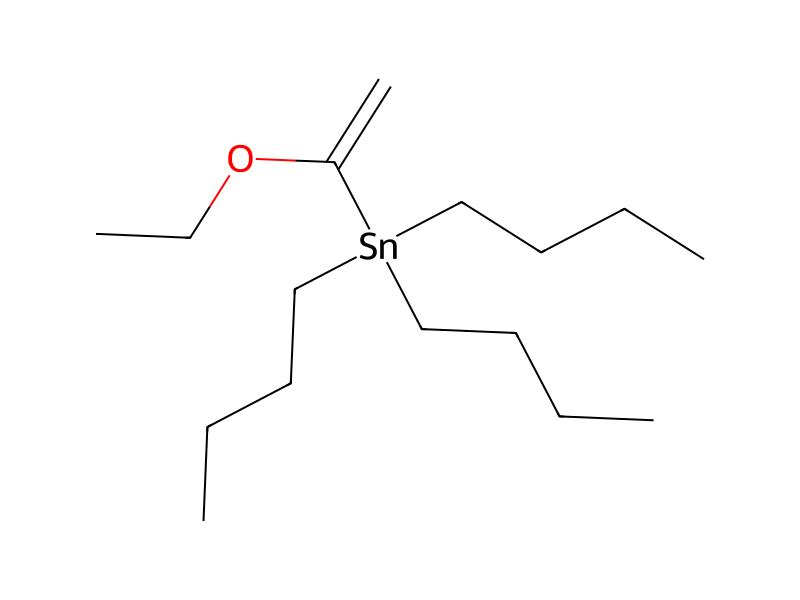
Br[C:2]1[CH:3]=[C:4]2[C:9](=[CH:10][CH:11]=1)[N:8]=[CH:7][CH:6]=[N:5]2.[CH2:12]([O:14]C([Sn](CCCC)(CCCC)CCCC)=C)[CH3:13].F[B-](F)(F)F.C([PH+](C(C)(C)C)C(C)(C)C)(C)(C)C>CN(C=O)C.C([O-])(=O)C.[Pd+2].C([O-])(=O)C>[N:8]1[C:9]2[C:4](=[CH:3][C:2]([C:12](=[O:14])[CH3:13])=[CH:11][CH:10]=2)[N:5]=[CH:6][CH:7]=1Participants
Reactant 3


Product 1

Reagents, catalysts & solvents 2


Procedure
A solution of 6-bromo-quinoxaline (261 mg, 1.25 mmol), 1-ethoxyvinyltri-n-butyltin (0.47 mL, 1.4 mmol), palladium(II) acetate (16 mg) and tri-t-butylphosphonium tetrafluoroborate (41 mg) in anhydrous DMF (4 mL) under a nitrogen atmosphere was heated at 120° C. for 1 hr. The reaction mixture was cooled to ambient temperature and partitioned between ethyl acetate (25 mL) and H2O (10 mL). The organic extraction was washed with brine, dried (MgSO4), filtered, and concentrated. The concentrate was chromatographed on silica gel eluting with ethyl acetate:hexanes (1:1) to provide 110 mg of the title compound. 1H NMR (300 MHz, CDCl3) δ 2.79 (s, 3 H), 8.18 (d, J=9 Hz, 1 H), 8.36 (dd, J=9 Hz, J=3 Hz, 1 H), 8.70 (d, J=3 Hz, 1 H), 8.95 (s, 2 H); MS (DCl/NH3) m/z 173 (M+H)+.
Workup
- custompartitioned between ethyl acetate (25 mL) and H2O (10 mL)
- extractionThe organic extraction
- washwas washed with brine
- dry with materialdried (MgSO4)
- filtrationfiltered
- concentrationconcentrated
- customThe concentrate was chromatographed on silica gel eluting with ethyl acetate:hexanes (1:1)
Sources & evidence
- ORD record
- ord-bf69d84871384c1eb6111f8fa0db674c
- Source dataset
- uspto-grants-2007_04
- Patent number
- US07205316B2
Reaction notes
Loading…