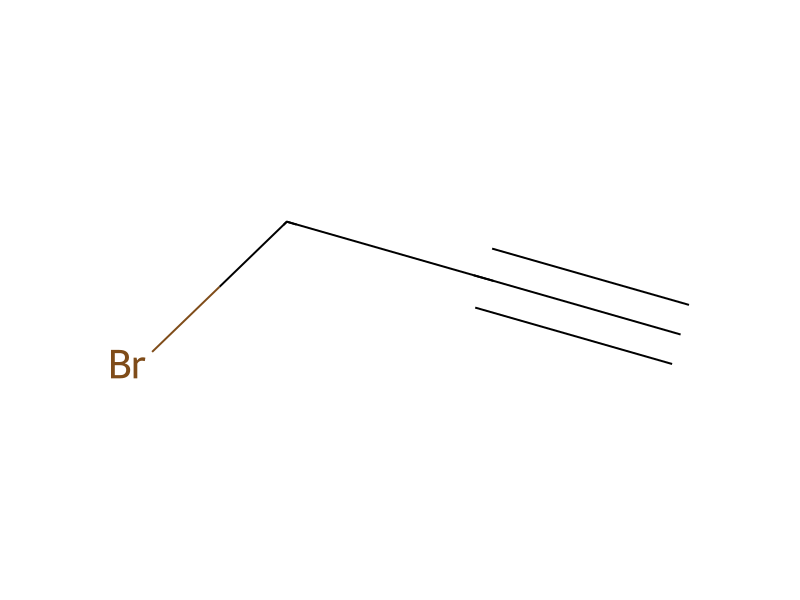
Propargyl bromide → HCID 87836339, compound
Reaction equation

[NH2:1][C:2]1[C:7]([OH:8])=[C:6]([Cl:9])[CH:5]=[C:4]([F:10])[C:3]=1[N:11]1[C:15](=[O:16])[N:14]([CH2:17][CH2:18][CH2:19][F:20])[N:13]=[N:12]1.[CH2:21](Br)[C:22]#[CH:23].C(=O)([O-])[O-].[K+].[K+]>C(#N)C>[NH2:1][C:2]1[C:7]([O:8][CH2:23][C:22]#[CH:21])=[C:6]([Cl:9])[CH:5]=[C:4]([F:10])[C:3]=1[N:11]1[C:15](=[O:16])[N:14]([CH2:17][CH2:18][CH2:19][F:20])[N:13]=[N:12]1Participants
5
Reactant 3


Product 1

Reagents, catalysts & solvents 1

Procedure
The mixture of 1-(2-amino-4-chloro-6-fluoro-3-hyroxyphenyl)(3-fluoropropyl)-tetrazolinone (0.28 g), propargyl bromide (0.13 g), and potassium carbonate (0.14 g) in acetonitrile (5 ml) was heated under reflux for 0.5 hour. The solvent and excess reagent were removed under reduced pressure. The residue was purified by a silica gel column, eluted with ethyl acetate to give the desired product (0.33 g).
Workup
- temperaturewas heated
- temperatureunder reflux for 0.5 hour
- customThe solvent and excess reagent were removed under reduced pressure
- customThe residue was purified by a silica gel column
- washeluted with ethyl acetate
Sources & evidence
- ORD record
- ord-1f6ca7811df1463da65e75bd102aa405
- Source dataset
- uspto-grants-2007_04
- Patent number
- USRE039590E1
Reaction notes
Loading…