Potassium Carbonate → 2-bromo-4-methyl-6-(3-trifluoromethyl-1H-pyrazol-1-yl)-pyridine
Reaction equation

Br[C:2]1[CH:7]=[C:6]([CH3:8])[CH:5]=[C:4]([Br:9])[N:3]=1.[F:10][C:11]([F:18])([F:17])[C:12]1[CH:16]=[CH:15][NH:14][N:13]=1.C(=O)([O-])[O-].[K+].[K+]>CN(C)C=O>[Br:9][C:4]1[CH:5]=[C:6]([CH3:8])[CH:7]=[C:2]([N:14]2[CH:15]=[CH:16][C:12]([C:11]([F:18])([F:17])[F:10])=[N:13]2)[N:3]=1Participants
5

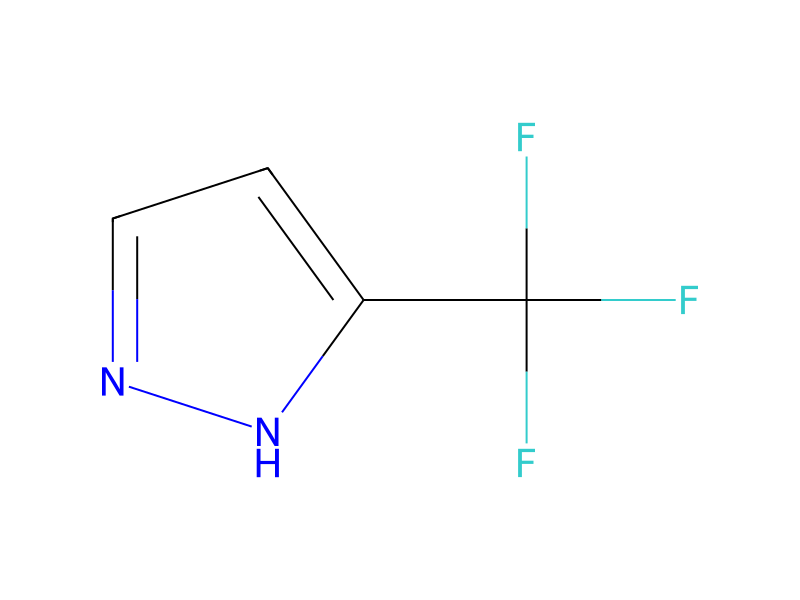



Conditions
- Temperature
- 90 °C
Procedure
A mixture of 2,6-dibromo-4-methylpyridine (33 mmol, obtained according to the method disclosed by WO 94/22833), 3-trifluoromethyl-1H-pyrazole (21 mmol), potassium carbonate (45 mmol) and N,N-dimethylformamide ((50 mL) is heated at 90° C. for 4 hours. The reaction mixture is partitioned between ethyl acetate ands water. The separated organic phase is washed with brine, dried over sodium sulfate and evaporated in vacuo to provide an oily residue which is purified by flash chromatography. To yield 1.9 g of the title compound.
Workup
- customobtained
- customThe reaction mixture is partitioned between ethyl acetate ands water
- washThe separated organic phase is washed with brine
- dry with materialdried over sodium sulfate
- customevaporated in vacuo
- customto provide an oily residue which
- customis purified by flash chromatography
Sources & evidence
- ORD record
- ord-0b70f3c3691540a69001dd9e0d525ece
- Source dataset
- uspto-grants-2002_09
- Patent number
- US06448204B1
Reaction notes
Loading…