Cyclohexene → 4-(Cyclohex-1-EN-1-YL)benzaldehyde
Reaction equation

Br[C:2]1[CH:9]=[CH:8][C:5]([CH:6]=[O:7])=[CH:4][CH:3]=1.[CH:10]1[CH2:15][CH2:14][CH2:13][CH2:12][CH:11]=1.C([O-])(=O)C.[Na+]>CN(C=O)C>[CH:6]([C:5]1[CH:8]=[CH:9][C:2]([C:10]2[CH2:15][CH2:14][CH2:13][CH2:12][CH:11]=2)=[CH:3][CH:4]=1)=[O:7]Participants
5
Reactant 3

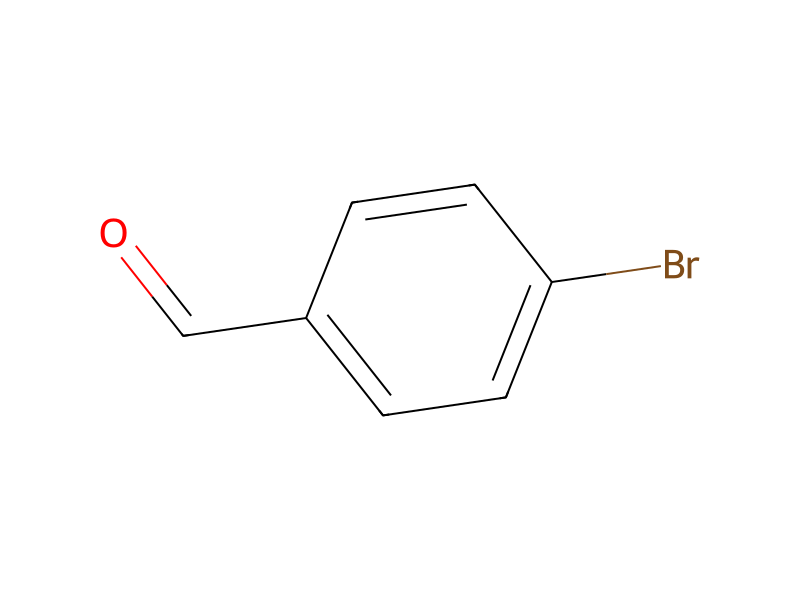

Product 1

Reagents, catalysts & solvents 1

Conditions
- Temperature
- 140 °C
Procedure
2 ml of the stock solution described in Example 23 are added to 18 ml of DMF. 9.26 g (50 mmols) of 4-bromobenzaldehyde, 5.58 ml (55 mmols) of cyclohexene and 4.52 g (55 mmols) of anhydrous sodium acetate are then added and the reaction mixture is stirred for 8 hours at 140° C. in a pressure tube. After working up as described in Example 1, the crude product is distilled in vacuo. 2.05 g (11.0 mmols) of 4-formylphenylcyclohexene are obtained in the form of a yellow liquid of boiling point 140°-150° C./2400 Pa; yield 22% of theory (conversion figure 2200; Pd content 0.01 mol %). The product is a mixture of isomers.
Workup
- distillationthe crude product is distilled in vacuo
Sources & evidence
- ORD record
- ord-1d6d65e27b8c466090f909db5f6b95df
- Source dataset
- uspto-grants-1986_01
- Patent number
- US04564479
Reaction notes
Loading…