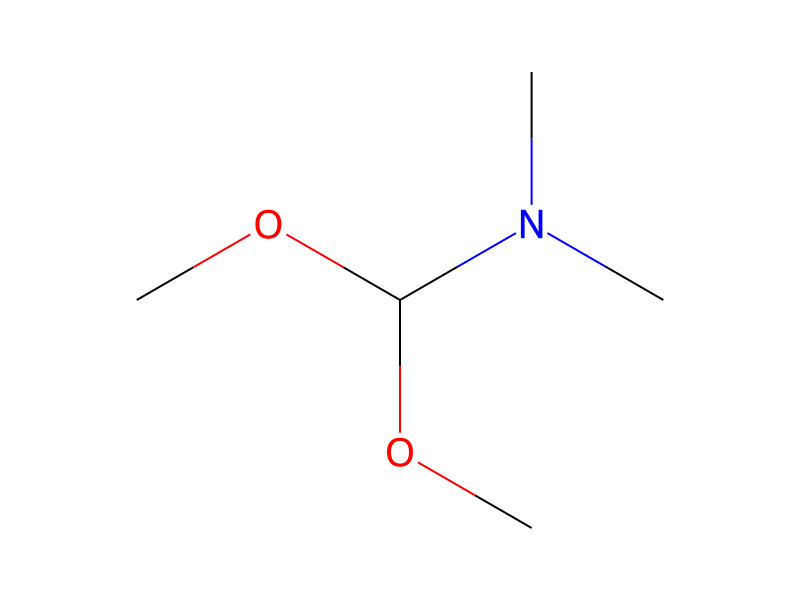
Dimethylformamide dimethyl acetal → HCID 54308355, compound
Reaction equation

[CH2:1]([O:3][C:4]([N:6]1[CH2:11][CH2:10][N:9]([CH2:12][C:13]([O:15][CH3:16])=[O:14])[CH2:8][CH2:7]1)=[O:5])[CH3:2].CO[CH:19](OC)[N:20]([CH3:22])[CH3:21]>CN(C=O)C>[CH2:1]([O:3][C:4]([N:6]1[CH2:11][CH2:10][N:9]([C:12]([C:13]([O:15][CH3:16])=[O:14])=[CH:19][N:20]([CH3:22])[CH3:21])[CH2:8][CH2:7]1)=[O:5])[CH3:2]Participants
Reactant 2

Product 1

Reagents, catalysts & solvents 1

Procedure
To a solution of the product of step (i) (10 g) in dry DMF (80 ml) was added dimethylformamide dimethyl acetal (DMFDMA) (30 ml) and the reaction mixture was heated to reflux. After 2 days a further quantity of DMFDMA (30 ml) was added and refluxing was continued for a further 2 days. The reaction mixture was evaporated and the residue partitioned between aqueous ammonium chloride solution and ethyl acetate. The organic layer was separated, washed with brine, dried (MgSO4) and evaporated. The residue was purified by flash chromatography on silica by elution with ethyl acetate to yield 1-ethoxycarbonyl-4-(1-dimethylamino-2-methoxycarbonylethen-2-yl)-piperazine (7 g) as an orange oil: NMR (CDCl3) δ 1.28 (3H, t), 2.90 (4H, m), 3.14 (6H, s), 3.50 (4H, m), 3.64 (3H, s), 4.12 (2H, q), 7.01 (1H, s); m/Z 286 (M+H)+.
Workup
- temperaturethe reaction mixture was heated to reflux
- temperaturerefluxing
- customThe reaction mixture was evaporated
- customthe residue partitioned between aqueous ammonium chloride solution and ethyl acetate
- customThe organic layer was separated
- washwashed with brine
- dry with materialdried (MgSO4)
- customevaporated
- customThe residue was purified by flash chromatography on silica by elution with ethyl acetate
Sources & evidence
- ORD record
- ord-7fefd102ecaa4997a20239909e30170a
- Source dataset
- uspto-grants-1998_05
- Patent number
- US05753659
Reaction notes
Loading…