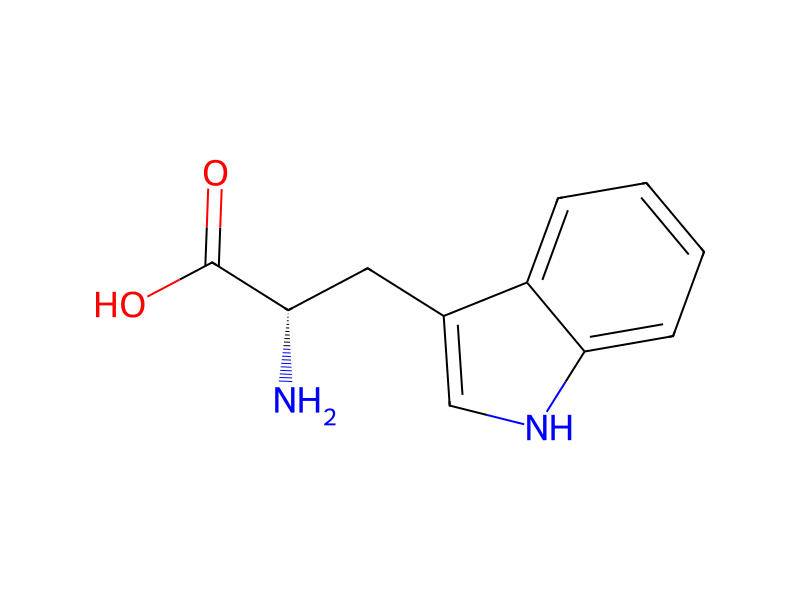
Hydrochloric Acid → L-Tryptophan
Reaction equation

[NH2:1][C@H:2]([C:5]([OH:7])=[O:6])[CH2:3]O.[C:8]1(S)[CH:13]=[CH:12][CH:11]=[CH:10][CH:9]=1.Cl.C1(S[CH2:23][C@@H:24](C(O)=O)[NH2:25])C=CC=CC=1>>[NH2:1][C@H:2]([C:5]([OH:7])=[O:6])[CH2:3][C:23]1[C:13]2[C:8](=[CH:9][CH:10]=[CH:11][CH:12]=2)[NH:25][CH:24]=1Participants
5



Procedure
Placed in a 100-ml Erlenmeyer flask were 19 ml of one of the L-serine solutions and 0.2 ml of one of the PLP solution. Thiophenol (0.5 ml) was added, followed by incubation at 35° C. for 5 minutes. The cell suspension (0.5 ml) was added, followed by incubation for 60 minutes under shaking. Sixty minutes later, 1 ml of 35% hydrochloric acid was added to terminate the reaction, and the concentration of S-phenyl-L-cysteine in the solution was quantitated by HPLC. The amount (g) of S-phenyl-L-cysteine formed in an hour per gram of the dried cells was defined as S-phenyl-L-cysteine forming activity.
Workup
- waitfollowed by incubation for 60 minutes
- customto terminate
- customthe reaction
Sources & evidence
- ORD record
- ord-e9e06ac8dfd54671914c2cc24dcdf01c
- Source dataset
- uspto-grants-1998_05
- Patent number
- US05756319
Reaction notes
Loading…