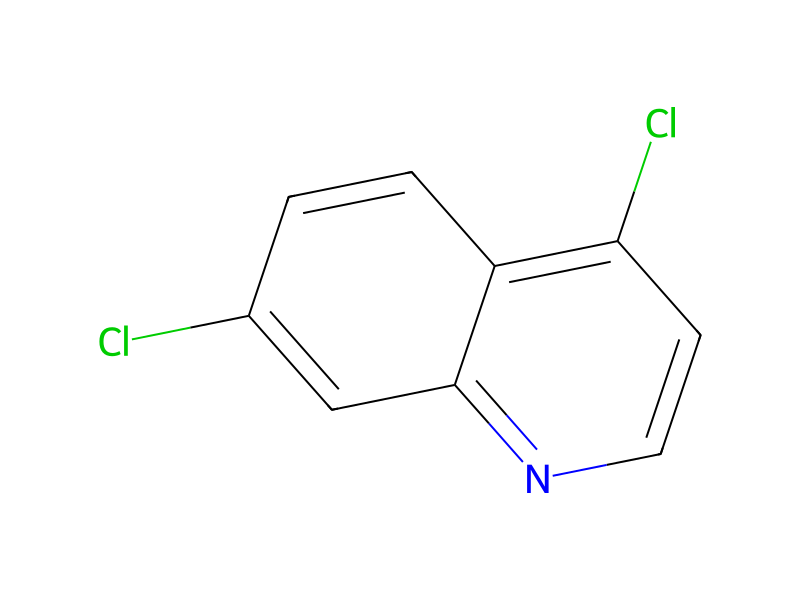
4,7-Dichloroquinoline → HCID 21101686, compound
Reaction equation

Cl[C:2]1[C:11]2[C:6](=[CH:7][C:8]([Cl:12])=[CH:9][CH:10]=2)[N:5]=[CH:4][CH:3]=1.[C:13]([O:17][C:18]([N:20]([CH3:26])[CH:21]1[CH2:25][CH2:24][NH:23][CH2:22]1)=[O:19])([CH3:16])([CH3:15])[CH3:14].N12CCN(CC1)CC2>CCO>[C:13]([O:17][C:18]([N:20]([CH3:26])[CH:21]1[CH2:25][CH2:24][N:23]([C:2]2[C:11]3[C:6](=[CH:7][C:8]([Cl:12])=[CH:9][CH:10]=3)[N:5]=[CH:4][CH:3]=2)[CH2:22]1)=[O:19])([CH3:16])([CH3:15])[CH3:14]Participants
5
Reactant 3


Product 1

Reagents, catalysts & solvents 1

Procedure
4,7-Dichloroquinoline (0.49 g, 2.0 mmol), 3-[tert-butoxycarbonyl(methyl)amino]pyrrolidine (1.96 mL, 10.0 mmol) and 1,4-diazabicyclo[2.2.2]octane (1.12 g, 10.0 mmol) are heated in EtOH for 15 h at reflux. The reaction mixture is concentrated, diluted with EtOAc, washed with water, dried (MgSO4), and concentrated. The residue is purified by column chromatography with hexane-EtOAc yielding the title product as a colorless solid.
Workup
- temperatureat reflux
- concentrationThe reaction mixture is concentrated
- additiondiluted with EtOAc
- washwashed with water
- dry with materialdried (MgSO4)
- concentrationconcentrated
- customThe residue is purified by column chromatography with hexane-EtOAc yielding the title product as a colorless solid
Sources & evidence
- ORD record
- ord-a2ea28908107421ab0de097ecc3dcbd7
- Source dataset
- uspto-grants-2007_05
- Patent number
- US07220856B2
Reaction notes
Loading…