Hydrochloric Acid → HCID 86586354, compound
Reaction equation

[CH3:1][C:2]1[CH:7]=[CH:6][C:5]([S:8]([O:11][CH2:12][C@H:13]2[O:18][C:17]3[CH:19]=[C:20]([N+:25]([O-])=O)[C:21]([O:23][CH3:24])=[CH:22][C:16]=3[O:15][CH2:14]2)(=[O:10])=[O:9])=[CH:4][CH:3]=1.Cl.[H][H]>C(OCC)(=O)C.[Pd]>[CH3:1][C:2]1[CH:7]=[CH:6][C:5]([S:8]([O:11][CH2:12][CH:13]2[O:18][C:17]3[CH:19]=[C:20]([NH2:25])[C:21]([O:23][CH3:24])=[CH:22][C:16]=3[O:15][CH2:14]2)(=[O:9])=[O:10])=[CH:4][CH:3]=1Participants
6
Reactant 3

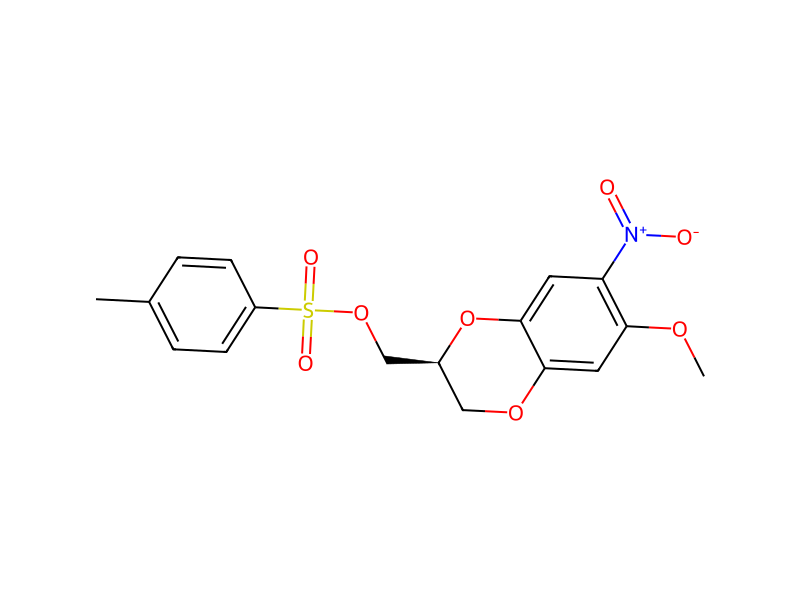

Product 1

Reagents, catalysts & solvents 2


Procedure
To a mixture of 3.74 g (9.40 mmole) of [(2S)-7-nitro-6-methoxy-2,3-dihydro-1,4-benzodioxin-2y]methyl 4-methylbenzenesulfonate and 2.5 mL of 4 N isopropanolic HCl in 200 mL of ethyl acetate was added 0.45 g of 10% palladium on carbon and the mixture treated with 50 psi of hydrogen on a Parr apparatus for 15 hours. The catalyst was then removed by filtration through celite and the filtrate concentrated in vacuum to give 3.41 g of the (R)-enantiomer of the title compound as beige solid hydrochloride salt. 1H-NMR (DSMO-d6): broad singlet 9.8 δ(2 H); doublet 7.8 δ(2 H); doublet 7.45 δ(2 H); singlet 6.85 δ(1 H); singlet 6.75 δ(1 H); multiplet 4.2-4.45 δ(4 H); multiplet 4.0 δ(1 H); singlet 3.8 δ(3 H); singlet 2.5 δ(3 H).
Workup
- customThe catalyst was then removed by filtration through celite
- concentrationthe filtrate concentrated in vacuum
Sources & evidence
- ORD record
- ord-1d4d90ccb0eb4a4a8edb4ba883818f52
- Source dataset
- uspto-grants-2003_07
- Patent number
- US06599915B2
Reaction notes
Loading…