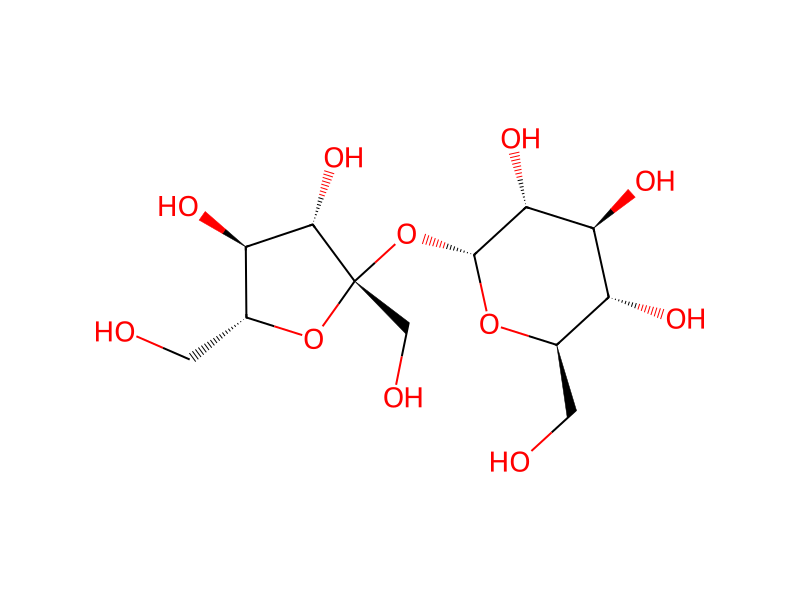
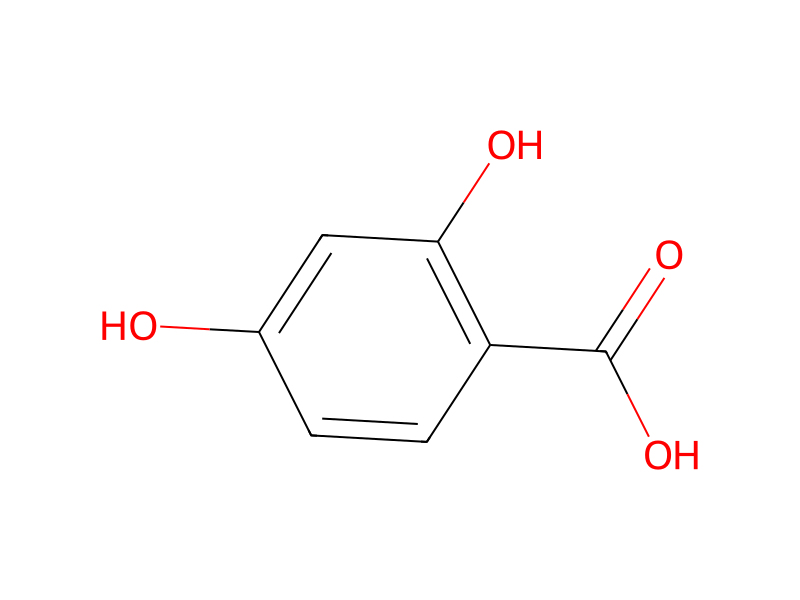
Sucrose → 2,4-Dihydroxybenzoic Acid
Reaction equation

C1C=CC([C:7]([C:9]2[CH:14]=[CH:13][C:12]([OH:15])=[CH:11][C:10]=2[OH:16])=[O:8])=CC=1.C(O)[C@H]1[O:23][C@H](O[C@]2(CO)O[C@H](CO)[C@@H](O)[C@@H]2O)[C@H](O)[C@@H](O)[C@@H]1O>>[OH:16][C:10]1[CH:11]=[C:12]([OH:15])[CH:13]=[CH:14][C:9]=1[C:7]([OH:8])=[O:23]Participants
3

Procedure
The same methodology as described in Example 7 was repeated with 2,4-DHB in place of 3-HB, to produce the dose response curve for 2,4-DHB (FIG. 2). From FIG. 2 it can be seen that 2,4-DHB also enhances the sweetness of the sucrose solution but there is little difference between the 400 ppm solution (SEV 6.5%) and the 1000 ppm solution (SEV 6.7%). The maximum attainable sweetness would appear to be about 6.7% SEV (based on a 5% sucrose solution).
Sources & evidence
- ORD record
- ord-807916d804f74d01ac678c8a75195971
- Source dataset
- uspto-grants-2011_02
- Patent number
- US07879376B2
Reaction notes
Loading…