Sodium Carbonate → 1,2-dimethyl-2H-pyrazolo[3,4-c]quinolin-4-amine
Reaction equation

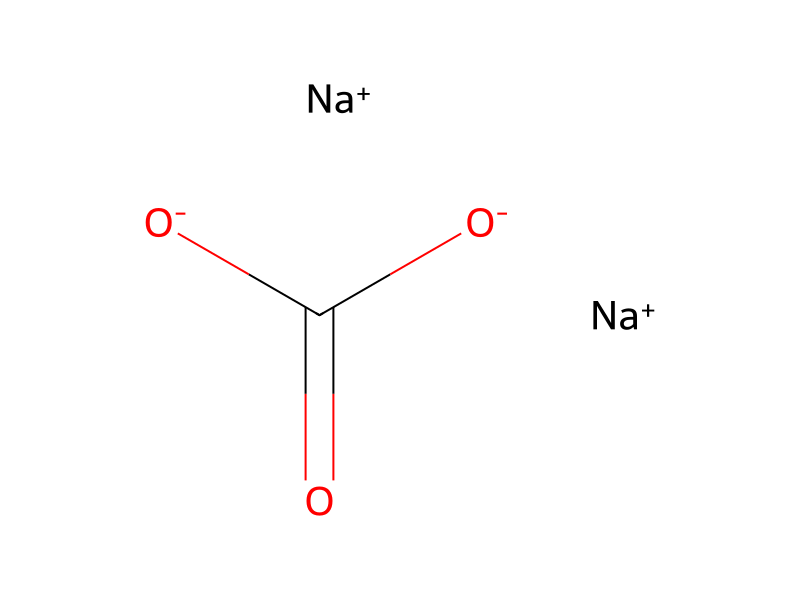
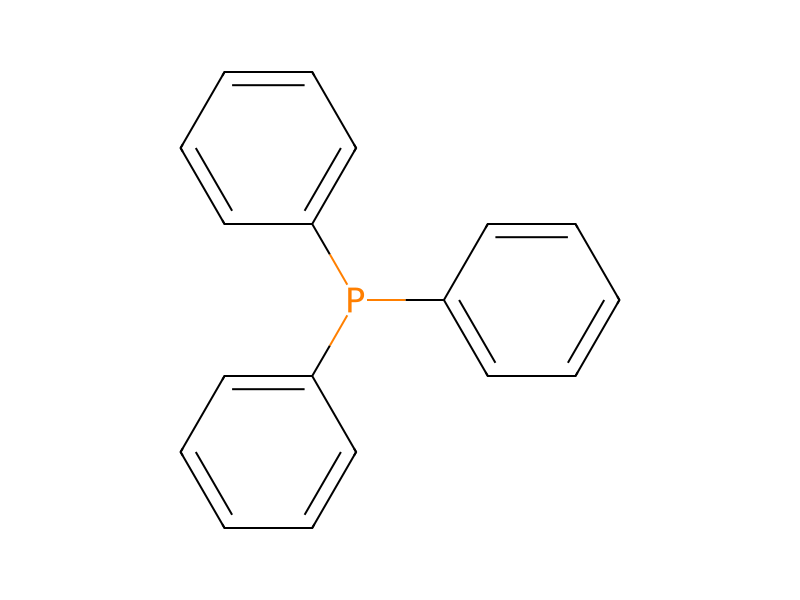
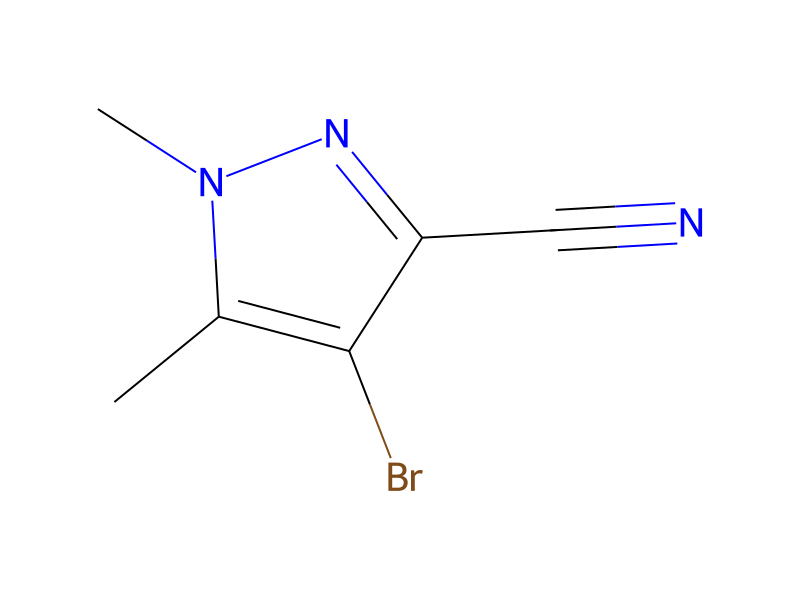
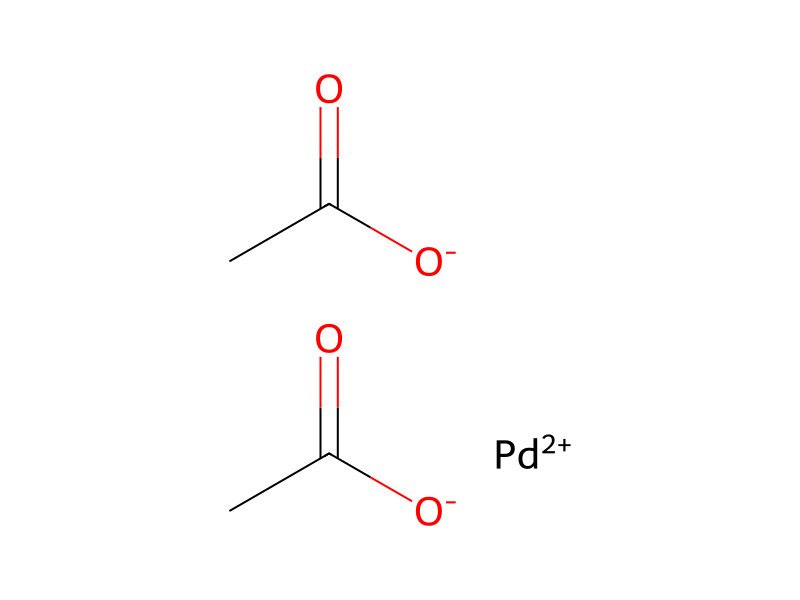
C1(P(C2C=CC=CC=2)C2C=CC=CC=2)C=CC=CC=1.Cl.[NH2:21][C:22]1[CH:27]=[CH:26][CH:25]=[CH:24][C:23]=1B(O)O.Br[C:32]1[C:33]([C:39]#[N:40])=[N:34][N:35]([CH3:38])[C:36]=1[CH3:37].C(=O)([O-])[O-].[Na+].[Na+]>C([O-])(=O)C.[Pd+2].C([O-])(=O)C.O.ClCCl.C(O)CC>[CH3:37][C:36]1[N:35]([CH3:38])[N:34]=[C:33]2[C:32]=1[C:23]1[CH:24]=[CH:25][CH:26]=[CH:27][C:22]=1[N:21]=[C:39]2[NH2:40]Participants
Reactant 4

Product 1

Reagents, catalysts & solvents 4
Conditions
- Temperature
- 100 °C
Procedure
Triphenylphosphine (0.10 g, 0.45 mmol), 2-aminophenylboronic acid hydrochloride (3.89 g, 22.0 mmol), and 4-bromo-1,5-dimethyl-1H-pyrazole-3-carbonitrile (prepared as described in Parts A-C of Example 5, 3.00 g, 15.0 mmol) were placed in a flask. After 1-propanol was added (22 mL), the flask was placed under vacuum and back-filled with nitrogen three times. Palladium (II) acetate (30 mg, 0.15 mmol) was added, followed by aqueous sodium carbonate (22.5 mL of 2 M) and water (4.4 mL). The reaction was heated overnight under a nitrogen atmosphere at 100° C. Additional 2-aminophenylboronic acid hydrochloride (1.0 g), palladium (II) acetate (approximately 10 mg), aqueous sodium carbonate (10 mL of 2 M), and water (5 mL) were added. The reaction was heated at 100° C. for 8 hours, then was allowed to cool to ambient temperature. The reaction mixture was partioned between dichloromethane and water. The organic layer was concentrated under reduced pressure and the crude product was purified by chromatography on a HORIZON HPFC system (silica gel, gradient elution with 0-30% CMA in chloroform). The appropriate fractions were combined and concentrated under reduced pressure. The residue was dissolved in dichloromethane and concentrated under reduced pressure, which resulted in the formation of a solid. Hexanes were added to the solid, which was isolated by filtration and crystallized from acetonitrile to yield 0.637 g of 1,2-dimethyl-2H-pyrazolo[3,4-c]quinolin-4-amine as white needles, mp>250° C.
Workup
- additionback-filled with nitrogen three times
- temperatureThe reaction was heated at 100° C. for 8 hours
- temperatureto cool to ambient temperature
- concentrationThe organic layer was concentrated under reduced pressure
- customthe crude product was purified by chromatography on a HORIZON HPFC system (silica gel, gradient elution with 0-30% CMA in chloroform)
- concentrationconcentrated under reduced pressure
- dissolutionThe residue was dissolved in dichloromethane
- concentrationconcentrated under reduced pressure, which
- customresulted in the formation of a solid
- customwhich was isolated by filtration
- customcrystallized from acetonitrile
Sources & evidence
- ORD record
- ord-3c29e927913b46a68c051655143cef0c
- Source dataset
- uspto-grants-2011_02
- Patent number
- US07879849B2
Reaction notes
Loading…