Pyrrolidine → HCID 66937954, compound
Reaction equation

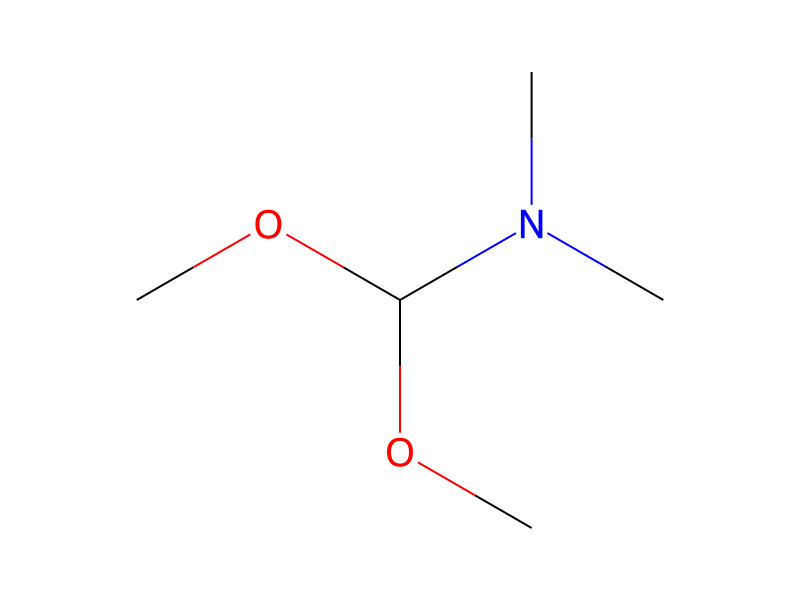
[Br:1][C:2]1[CH:7]=[C:6]([F:8])[CH:5]=[C:4]([N+:9]([O-:11])=[O:10])[C:3]=1[CH3:12].CN(C(OC)OC)C.[NH:21]1[CH2:25][CH2:24][CH2:23][CH2:22]1.O1CCO[CH2:28][CH2:27]1>>[Br:1][C:2]1[CH:7]=[C:6]([F:8])[CH:5]=[C:4]([N+:9]([O-:11])=[O:10])[C:3]=1[CH:12]=[C:27]([N:21]1[CH2:25][CH2:24][CH2:23][CH2:22]1)[CH3:28]Participants




Conditions
- Temperature
- 100 °C
Procedure
To a solution of 1-bromo-5-fluoro-2-methyl-3-nitro-benzene (7.49 g, 31.8 mmol) in dioxane (40 mL) were added DMF-DMA (21.0 mL, 158 mmol) and pyrrolidine (2.6 mL, 31.1 mmol). The reaction mixture was heated at 100° C. for 3 h. The mixture was cooled to RT and concentrated in vacuo to give 1-[2-(2-bromo-4-fluoro-6-nitro-phenyl)-1-methyl vinyl]-pyrrolidine as a dark red residue. To a suspension of the pyrrolidine (10.0 g, 31.7 mmol) and Raney®-Nickel (suspension in H2O, 15 mL) in MeOH:THF (1:1, 150 mL) was added hydrazine monohydrate (2.3 mL, 47.4 mmol) at 0° C. and the mixture stirred at RT for 5 hours. The reaction mixture was then filtered through Celite and the filter cake washed with EtOAc. The filtrate was concentrated in vacuo and the resulting residue was purified by column chromatography (silica gel, pentane:EtOAc 75:25) to provide the title compound as a pale oil (2.57 g, 37%).
Workup
- temperatureThe mixture was cooled to RT
- concentrationconcentrated in vacuo
Sources & evidence
- ORD record
- ord-297f4ed9a55a48559d4fbd735294060f
- Source dataset
- uspto-grants-2011_02
- Patent number
- US07893060B2
Reaction notes
Loading…