Diisopropylethylamine → HCID 44138497, compound
Reaction equation

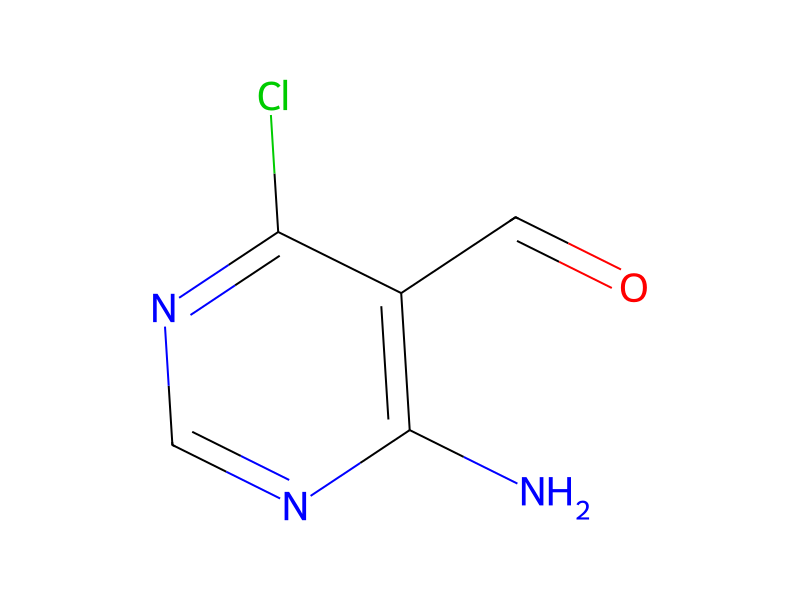
[NH2:1][C:2]1[C:7]([CH:8]=[O:9])=[C:6](Cl)[N:5]=[CH:4][N:3]=1.[F:11][C:12]1[CH:13]=[C:14]([CH:26]=[CH:27][CH:28]=1)[CH2:15][N:16]1[C:24]2[C:19](=[CH:20][C:21]([NH2:25])=[CH:22][CH:23]=2)[CH:18]=[N:17]1.C(N(C(C)C)CC)(C)C>CS(C)=O>[NH2:1][C:2]1[C:7]([CH:8]=[O:9])=[C:6]([NH:25][C:21]2[CH:20]=[C:19]3[C:24](=[CH:23][CH:22]=2)[N:16]([CH2:15][C:14]2[CH:26]=[CH:27][CH:28]=[C:12]([F:11])[CH:13]=2)[N:17]=[CH:18]3)[N:5]=[CH:4][N:3]=1Participants
5
Reactant 3


Product 1

Reagents, catalysts & solvents 1

Conditions
- Temperature
- 100 °C
Procedure
To a mixture of 4-amino-6-chloro-pyrimidine-5-carbaldehyde (95.5 mg, 0.61 mmol) and 1-(3-fluoro-benzyl)-1H-indazol-5-ylamine (147 mg, 0.61 mmol) in DMSO (1.5 mL) was added diisopropylethylamine (DIEA, 79 mg, 0.61 mmol). The mixture was stirred at 100° C. for 2 h, cooled to room temperature, then partitioned between ethyl acetate and H2O. The combined ethyl acetate extracts were dried over Na2SO4 and evaporated to afford a yellow solid, which was used in the next step without further purification.
Workup
- temperaturecooled to room temperature
- custompartitioned between ethyl acetate and H2O
- dry with materialThe combined ethyl acetate extracts were dried over Na2SO4
- customevaporated
- customto afford a yellow solid, which
- customwas used in the next step without further purification
Sources & evidence
- ORD record
- ord-d4c1453e96244806b7d2699a7e34b52c
- Source dataset
- uspto-grants-2011_02
- Patent number
- US07893064B2
Reaction notes
Loading…