Dimethylformamide → 2-(3,4-dimethoxyphenyl)-2-methylpropanenitrile
Reaction equation

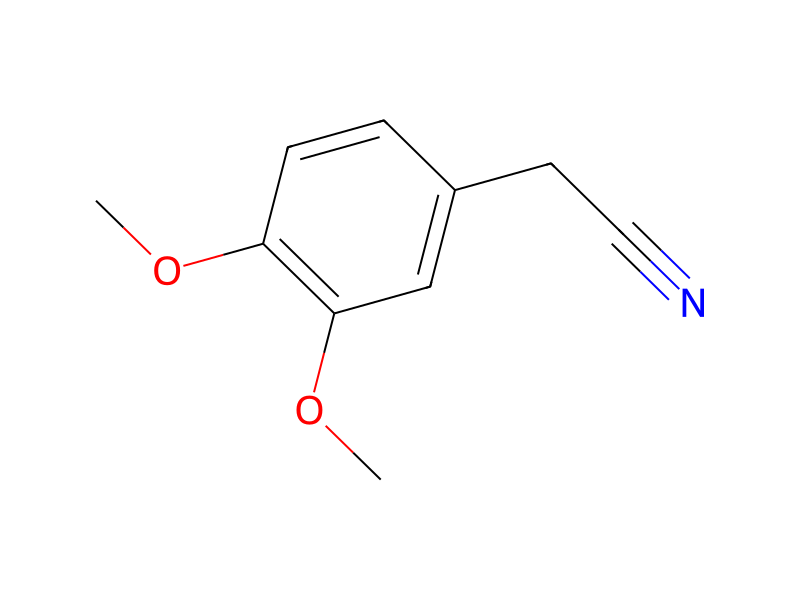
[CH3:1][O:2][C:3]1[CH:4]=[C:5]([CH2:11][C:12]#N)[CH:6]=[CH:7][C:8]=1[O:9][CH3:10].[H-].[Na+].[CH3:16]I.C[N:19]([CH3:22])C=O>>[CH3:1][O:2][C:3]1[CH:4]=[C:5]([C:11]([CH3:12])([CH3:16])[C:22]#[N:19])[CH:6]=[CH:7][C:8]=1[O:9][CH3:10]Participants




Procedure
A conventional alkylation reaction was carried out using a dimethylformamide solution (10 ml) of 1.77 g of 2-(3,4-dimethoxyphenyl)acetonitrile, 1.00 g of sodium hydride and 4.26 g of methyl iodide to give 1.78 g of 2-(3,4-dimethoxyphenyl)-2-methylpropionitrile. A conventional catalytic hydrogenation reaction was carried out using an ethanolic solution (30 ml) of 1.75 g of 2-(3,4-dimethoxyphenyl)-2-methylpropionitrile, 3.0 ml of an aqueous 28% ammonia solution and 4.3 g of Raney nickel to give 1.59 g of 2-(3,4-dimethoxyphenyl)-2-methylpropylamine. Then, a conventional cyclization reaction was carried out using a formic acid solution (8 ml) of 1.58 g of 2-(3,4-dimethoxyphenyl)-2-methylpropylamine and 0.252 g of paraformaldehyde to give 1.34 g of 6,7-dimethoxy-4,4-dimethyl-1,2,3,4-tetrahydroisoquinoline as a pale yellow oily substance. A conventional alkylation reaction was carried out using a solution (10 ml) of 1.77 g of 2-(3,4-dimethoxyphenyl)acetonitrile in dimethylformamide, 1.00 g of sodium hydride and 4.26 g of methyl iodide to give 1.78 g of 2-(3,4-dimethoxyphenyl)-2-methylpropionitrile.
Workup
- customA conventional alkylation reaction
Sources & evidence
- ORD record
- ord-ebabc73269e542eeaa95e267ea8f52cf
- Source dataset
- uspto-grants-2003_06
- Patent number
- US06573279B1
Reaction notes
Loading…