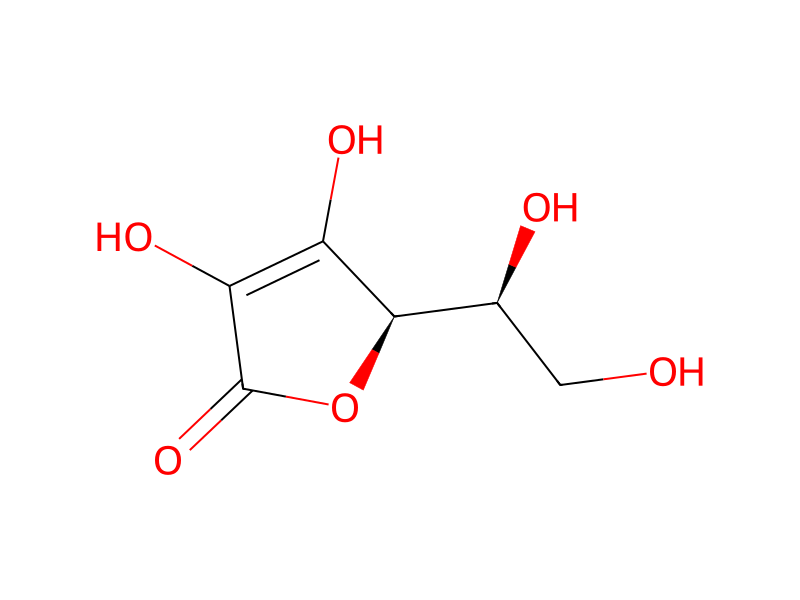
Hydrochloric Acid → L-Ascorbic Acid
Reaction equation

[CH2:1]([OH:13])[C@H:2]([OH:12])[C@@H:3](O)[C@H:4]([OH:10])[C:5]([C:7]([OH:9])=[O:8])=[O:6].Cl>>[O:8]=[C:7]1[O:9][C@H:3]([C@H:2]([CH2:1][OH:13])[OH:12])[C:4]([OH:10])=[C:5]1[OH:6]Participants
3


Procedure
The reaction of 2-keto-L-gulonic acid with 36% hydrochloric acid is described, for example, in DE 29 39 052. After reaction at 100° C. and after removal of the hydrochloric acid by distillation, a yield of 87% of theory of L-ascorbic acid is obtained. The disadvantage of the process, however, is the rapid decomposition of the ascorbic acid at 100° C., so that an increased formation of by-products and an intense black coloration of the solution occurs. On account of the large amount of by-products, isolation of the ascorbic acid is associated with further, not inconsiderable losses of material.
Workup
- customAfter reaction at 100° C.
- customafter removal of the hydrochloric acid
- distillationby distillation
Sources & evidence
- ORD record
- ord-f6f373d9065b455696fee8bcc0ce9cee
- Source dataset
- uspto-grants-2003_06
- Patent number
- US06573393B1
Reaction notes
Loading…