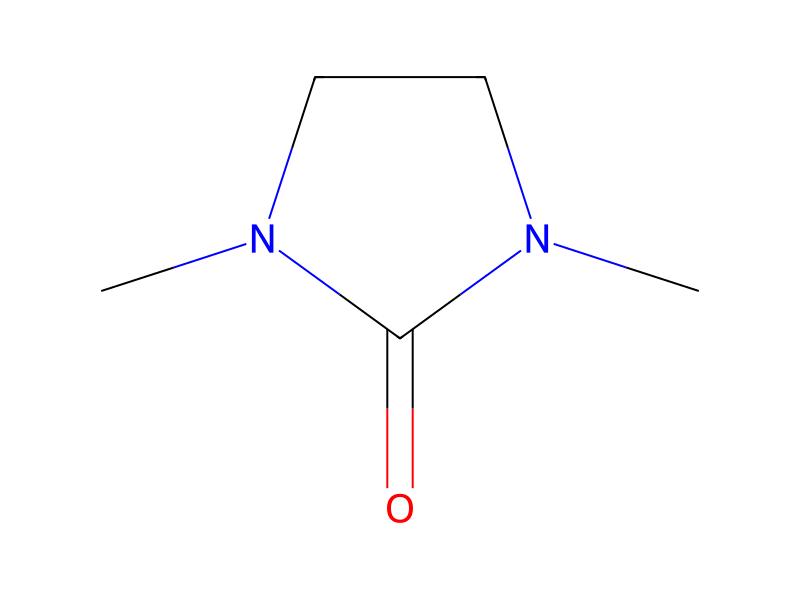
1,3-Dimethyl-2-imidazolidinone → 3,4-Dihydroxybenzonitrile
Reaction equation

C1[O:11][C:10]2[CH:9]=[CH:8][C:5]([C:6]#[N:7])=[CH:4][C:3]=2[O:2]1.C([N-]C(C)C)(C)C.[Li+].CN1CCN(C)C1=O>>[OH:2][C:3]1[CH:4]=[C:5]([CH:8]=[CH:9][C:10]=1[OH:11])[C:6]#[N:7]Participants
4


Procedure
As a conventional process for producing 3,4-dihydroxybenzonitrile from 3,4-methylenedioxybenzonitrile, for example, J. Org. Chem., 62, 4097 (1977) discloses a process in which 3,4-methylenedioxybenzonitrile is reacted with lithium diisopropylamide in an excess molar amount (five times by mole or more) in a reaction medium consisting of 1,3-dimethyl-2-imidazolidinone at a high temperature of 185° C., to produce 3,4-dihydroxybenzonitrile with a yield of 94%. This process is, however, disadvantageous as an industrial process in that lithium diisopropylamide, which has a high ignition property, must be employed, and the reaction conditions are very severe and a complicated after-treatment is necessary.
Sources & evidence
- ORD record
- ord-de88b9afa37b493b9d3c6bb3f3e9fa45
- Source dataset
- uspto-grants-2003_06
- Patent number
- US06573397B2
Reaction notes
Loading…