Potassium Carbonate → HCID 9964216, compound
Reaction equation

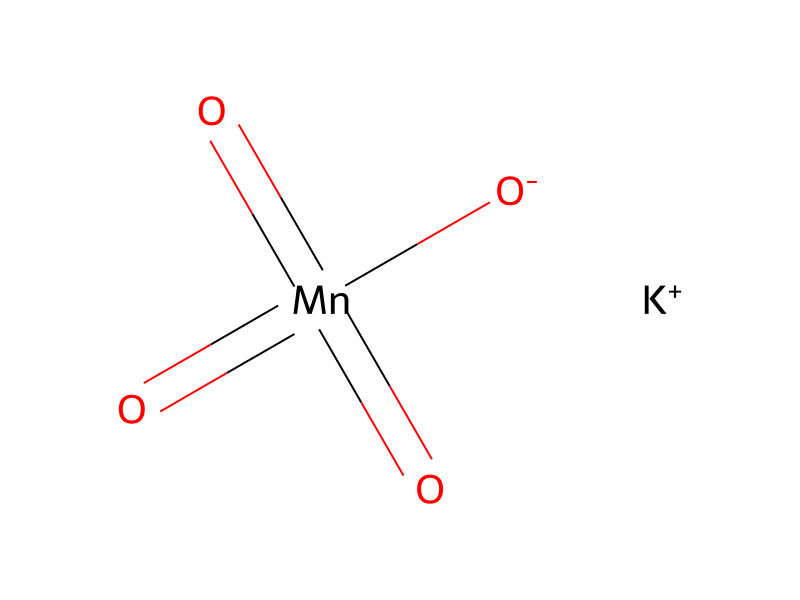
[CH3:1][CH:2]([CH2:4][C:5]([CH2:7][CH:8](C=C)[CH3:9])=[O:6])[CH3:3].[C:12](=[O:15])([O-])[O-:13].[K+].[K+].I([O-])(=O)(=O)=O.[K+].[Mn]([O-])(=O)(=O)=O.[K+].[K].[OH-].[K+]>O1CCOCC1.O>[CH3:9][CH:8]([CH2:7][C:5](=[O:6])[CH2:4][CH:2]([CH3:3])[CH3:1])[C:12]([OH:13])=[O:15]Participants
Reactant 6





Product 1

Reagents, catalysts & solvents 1

Conditions
- Temperature
- 6 °C
Procedure
To a vigorously stirred solution of dihydrotagetone (4) (5 g, 33 mmole) in 1,4-dioxane-water (250 mL, 4:1) is added potassium carbonate (7 g,) followed by powdered potassium metaperiodate (15 g, 70 mmol) and then 0.25 g of powdered potassium permanganate. The remaining powdered potassium metaperiodate (35 g, 163.6 mmole) and potassium permnaganate (0.4-0.6 g) was added in small fractions within 30-40 minutes. The reaction mixture was left at room temperature for overnight and the solution, which was initially deep purple turned into light brown solution. The mixture was made alkaline with 10% potassium hydroxide and filtered and then residue was further washed with aqueous-dioxane mixture. The filtrate and washings were combined and the dioxane was evaporated under reduced pressure. The aqueous layer was extracted with ethylacetate (15 mLx 2) to remove unwanted impurities. The aqueous layer was cooled at 4-8° C. and acidified with dilute acid and then extracted with ethylacetate (3×25 mL). The ethylacetate layers were then combined and washed with saturated sodium bisulphate (to destroy the excess permanganate), sodium chloride (3×15 m), dried over anhydrous sodium sulphate and filtered. The solvent was removed to afford a crude liquid which was loaded on silica gel column and the column was eluted with an increasing amount of hexane/ethyl acetate (100:0 to 95:5). The fractions were monitored on TLC plate and the desired fractions were combined and solvent was removed under vacuum to afford 2,6-dimethyl-4-oxo-heptanoic acid in 68% yield as a viscous liquid; Rf=0.69 (toluene:ethylacetate:methanol:6.5:3.5:0.1 mL); IR (film) λmax 2958, 1709, 1465, 1376, 937 cm−1; 1H NMR δ10.53 (s, 1H, COOH), 3.03-2.94 (m, 1H, 2-CH), 2.91-2.82 (m, 1H, 6-CH), 2.50-2.06 (m, 4H, 3-CH2 and 5-CH2), 1.23-1.20 (d, 3H, 9-CH3), 0.99-0.97 and 0.92-0.90 (2d, 6H, 7-CH3 and 8-CH3) (FIG. 1); 13C NMR 208.66 (COOH, C-1), 181.94 (C═O, C-4), 51.71 (C-2), 45.89 (C-6), 34.39 (C-3), 24.54 (C-5), 22.39 (2×C-7 and C-8), 16.73 (C-9) (FIG. 2).
Workup
- filtrationfiltered
- washresidue was further washed with aqueous-dioxane mixture
- customthe dioxane was evaporated under reduced pressure
- extractionThe aqueous layer was extracted with ethylacetate (15 mLx 2)
- customto remove unwanted impurities
- additionwith dilute acid
- extractionextracted with ethylacetate (3×25 mL)
- washwashed with saturated sodium bisulphate (
- customto destroy the excess permanganate), sodium chloride (3×15 m)
- dry with materialdried over anhydrous sodium sulphate
- filtrationfiltered
- customThe solvent was removed
- customto afford a crude liquid which
- washthe column was eluted with an increasing amount of hexane/ethyl acetate (100:0 to 95:5)
- customsolvent was removed under vacuum
Sources & evidence
- ORD record
- ord-f2d5fc4f6feb49a78e083c85ff47b07d
- Source dataset
- uspto-grants-2003_06
- Patent number
- US06579992B2
Reaction notes
Loading…