p-Fluoronitrobenzene → HCID 13580532, compound
Reaction equation

[H-].[Na+].[CH3:3][C:4]1[C:5]([CH:10]([CH2:13][OH:14])[CH2:11][OH:12])=[N:6][CH:7]=[CH:8][CH:9]=1.F[C:16]1[CH:21]=[CH:20][C:19]([N+:22]([O-:24])=[O:23])=[CH:18][CH:17]=1>CN(C)C=O>[OH:12][CH2:11][CH:10]([C:5]1[C:4]([CH3:3])=[CH:9][CH:8]=[CH:7][N:6]=1)[CH2:13][O:14][C:16]1[CH:21]=[CH:20][C:19]([N+:22]([O-:24])=[O:23])=[CH:18][CH:17]=1Participants
Reactant 3
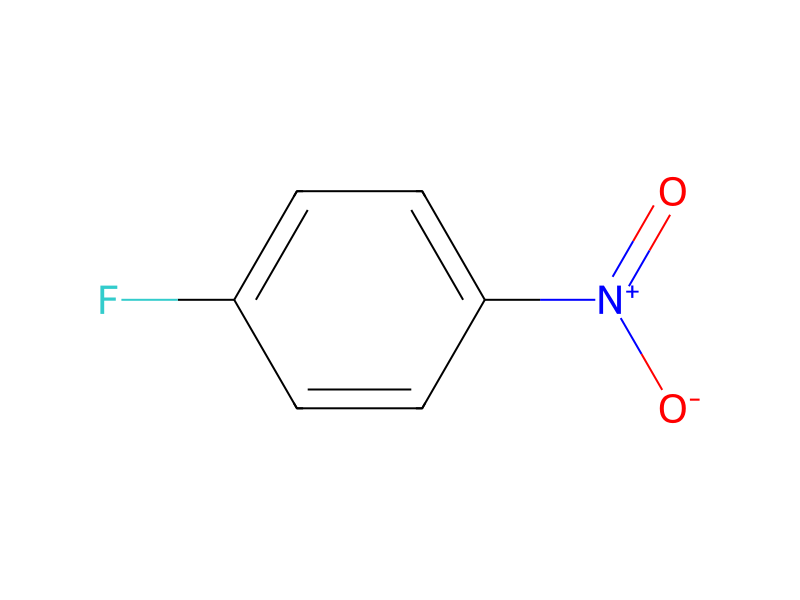


Product 1

Reagents, catalysts & solvents 1

Procedure
60% Oil-borne sodium hydride (2.8 g) was added little by little to a solution of 2-(3-methyl-2-pyridyl)-1,3-propylene glycol (10.0 g) and p-fluoronitrobenzene (8.45 g) in dimethylformamide (100 ml) under ice-cooling with stirring. After stirring under ice-cooling for 1 hour, the reaction solution was poured in ice-cold water, and the aqueous mixture was extracted with ethyl acetate. The ethyl acetate layer was washed with water, dried (MgSO4) and freed of the solvent by distillation, and the residue was chromatographed on a silica-gel (200 g) column. Elution was effected with cyclohexane-ethyl acetate (3:1, V/V) to give 4-[3-hydroxy-2-(3-methyl-2-pyridyl)propoxy]nitrobenzene in the form of crystals. Yield of 9.6 g. Recrystallization from ethyl acetatehexane produced colorless prisms. m.p. 135°-136° C.
Workup
- temperaturecooling
- stirringAfter stirring under ice-
- temperaturecooling for 1 hour
- additionthe reaction solution was poured in ice-cold water
- extractionthe aqueous mixture was extracted with ethyl acetate
- washThe ethyl acetate layer was washed with water
- dry with materialdried (MgSO4)
- distillationfreed of the solvent by distillation
- customthe residue was chromatographed on a silica-gel (200 g) column
- washElution
Sources & evidence
- ORD record
- ord-7dd1f63ac8f040df800de7a7f1c6836f
- Source dataset
- uspto-grants-1986_04
- Patent number
- US04582839
Reaction notes
Loading…