Benzaldehyde → 5-Benzylidenehydantoin
Reaction equation

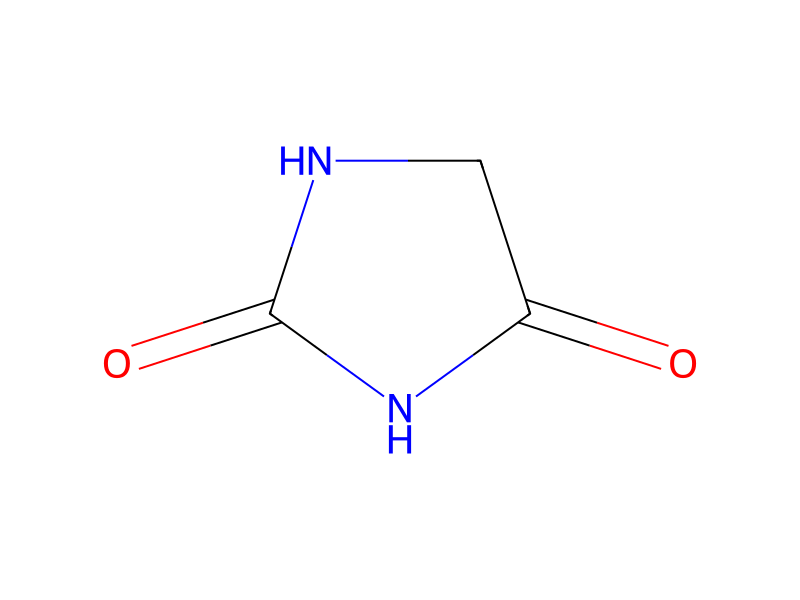
[NH:1]1[CH2:7][C:5](=[O:6])[NH:4][C:2]1=[O:3].[CH:8](=O)[C:9]1[CH:14]=[CH:13][CH:12]=[CH:11][CH:10]=1.C([O-])(=O)C.[NH4+]>C(O)(=O)C>[CH:8](=[C:7]1[NH:1][C:2](=[O:3])[NH:4][C:5]1=[O:6])[C:9]1[CH:14]=[CH:13][CH:12]=[CH:11][CH:10]=1Participants
Reactant 3


Product 1

Reagents, catalysts & solvents 1

Procedure
Similar to the procedure of U.S. Pat. No. 4,345,072, a mixture comprising hydantoin (25 g, 0.25 mole), benzaldehyde (29.3 g, 0.275 mole), ammonium acetate (19.3 g, 0.25 mole) and glacial acetic acid (60 g) were placed in a round bottom flask fitted with stirrer, condenser, thermometer and heating mantle. The white solids became yellow on heating. All the solids dissolved when the temperature reached between 120° C. and 134° C. The mixture was refluxed for one-half hour (125° to 134° C.) and then held at 120° C. for 4 hours with stirring. Solids crystallized out on cooling to room temperature. The solid was suction filtered, water washed and then ethanol washed. After air drying, the yellow orange solid had a weight of 38.0 g for an 81% yield. The melting point of the 5-benzalhydantoin obtained was determined to be 218°-220° C. which corresponds to the melting point reported in BIOCHEM J. 29, 542 (1935).
Workup
- customfitted with stirrer, condenser
- temperaturethermometer and heating mantle
- temperatureon heating
- dissolutionAll the solids dissolved when the temperature
- customreached between 120° C. and 134° C
- temperatureThe mixture was refluxed for one-half hour (125° to 134° C.)
- customSolids crystallized out
- filtrationfiltered
- washwater washed
- washethanol washed
- customAfter air drying
Sources & evidence
- ORD record
- ord-d775eca4a8fe4d189d791c7b2cdbe06b
- Source dataset
- uspto-grants-1986_04
- Patent number
- US04582903
Reaction notes
Loading…