Dichloromethane → Potassium 2-ethylhexanoate
Reaction equation

C(Cl)Cl.[CH2:4]([CH:6]([CH2:10][CH2:11][CH2:12][CH3:13])[C:7]([OH:9])=[O:8])[CH3:5].CC(C)([O-])C.[K+:19]>C1COCC1>[CH2:4]([CH:6]([CH2:10][CH2:11][CH2:12][CH3:13])[C:7]([O-:9])=[O:8])[CH3:5].[K+:19]Participants
Reactant 3



Product 1
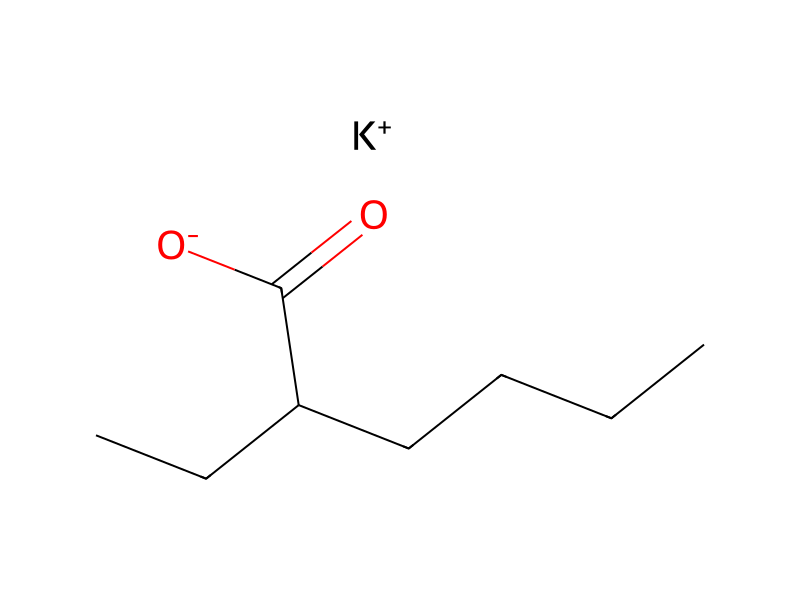
Reagents, catalysts & solvents 1

Conditions
- Temperature
- 0 °C
Procedure
To a dry flask under N2 atmosphere there was added 37.5 ml. of methylene chloride, 2.5 ml. of THF and 0.88 ml. of 2-ethylhexanoic acid. The solution was cooled to 0° C. and 3.25 ml. of potassium tertbutoxide in THF solution (1.6M of t-BuOK) was added to form in situ the potassium 2-ethylhexanoate salt base. To this mixture there was added 3.10 g. of the 3-hydroxymethyl-cephalosporin reactant, named in Example 1, part D, and 0.122 g. of DMAP and 0.84 ml. of triethylamine, followed by 3 ml. of CH2Cl2 containing 0.485 ml. of α-chloropropionyl chloride. When the addition was complete, a second 0.84 ml. portion of triethylamine and 3 ml. of CH2Cl2 solution containing 0.485 ml. of α-chloropropionyl chloride was added. The resulting reaction mixture was then added to 40 ml. of water containing 5 ml. of 1M sulfuric acid. Then 8 ml. of hexane were added. The reaction mixture was filtered and dried to obtain 2.29 g. of the hereinabove named 3-(α-chloropropionyloxymethyl)-compound. The NMR spectrum for this product was similar to that described in Example 1, but with the 3'-CH2 reading at 4.9(m), the -CHCl at 4.4(q) and the CHCl-CH3 at 1.5(d).
Workup
- additionTo a dry flask under N2 atmosphere there was added 37.5 ml
Sources & evidence
- ORD record
- ord-e46a45d24cc94315b4f3eb4eace022f3
- Source dataset
- uspto-grants-1986_04
- Patent number
- US04584371
Reaction notes
Loading…