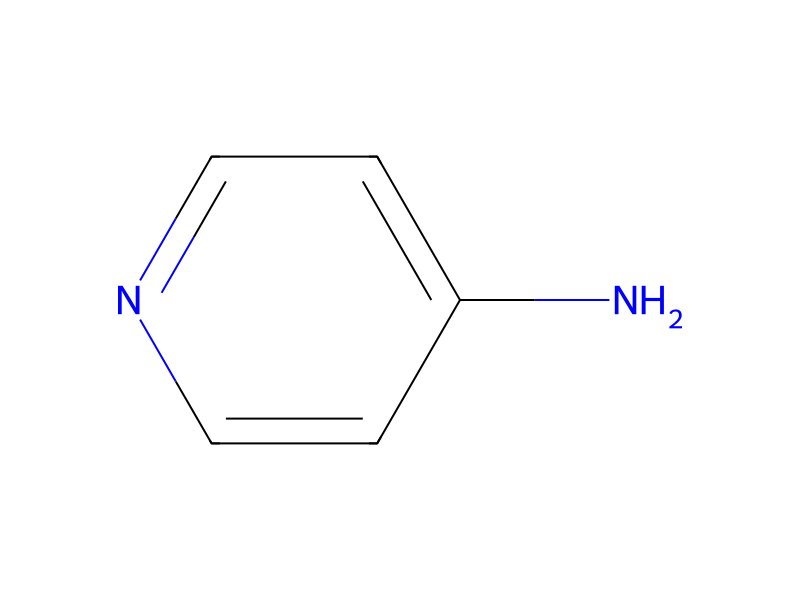
4-Aminopyridine → HCID 54204103, compound
Reaction equation

S(Cl)(Cl)=O.[CH:5]1([N:10]2[C:18]3[C:13](=[CH:14][CH:15]=[C:16]([C:19]([OH:21])=O)[CH:17]=3)[C:12]([CH2:22][CH3:23])=[N:11]2)[CH2:9][CH2:8][CH2:7][CH2:6]1.CN(C=O)C.[NH2:29][C:30]1[CH:35]=[CH:34][N:33]=[CH:32][CH:31]=1>C1(C)C=CC=CC=1.O.N1C=CC=CC=1>[N:33]1[CH:34]=[CH:35][C:30]([NH:29][C:19]([C:16]2[CH:17]=[C:18]3[C:13]([C:12]([CH2:22][CH3:23])=[N:11][N:10]3[CH:5]3[CH2:6][CH2:7][CH2:8][CH2:9]3)=[CH:14][CH:15]=2)=[O:21])=[CH:31][CH:32]=1Participants







Procedure
46 μL (0.629 mmol, 1.3 equiv) thionyl chloride were added to a room temperature solution of 125 mg (0.484 mmol, 1.0 equiv) 1-cyclopentyl-3-ethyl-1H-indazole-6-carboxylic acid and 5 μL DMF in 5 mL anhydrous toluene. The reaction mixture was heated to reflux for 2 hours, then cooled to room temperature, concentrated to dryness on a rotary evaporator, and dried at high vacuum, room temperature for several hours. The crude acid chloride was dissolve din 5 mL anhydrous pyridine, 50 mg (0.532 mmol, 1.1 equiv) 4-aminopyridine were added, and the mixture heated to 40° C. for 1 hour. The reaction mixture was cooled to room temperature and allowed to stand overnight. 10 mL H2O were added, and the mixture was concentrated to dryness on a rotary evaporator. The residue was taken up in 50 mL H2O and 25 mL CH2Cl2, and the layers separated. The aqueous layer was extracted 1×25 mL CH2Cl2. The organic extracts were combined, washed 1×10 mL each H2O, brine, and dried over Na2SO4. Filtration, concentration of filtrate and drying gave 133 mg of a white foam, which was purified on a silica gel column (25% CH3OH/CH2Cl2) to give 122 mg of white needles. Recrystallization from ethyl acetate/hexanes gave 101 mg (62%) of white shiny plates: mp 144-146° C.; Anal. calcd for C20H22N4O: C, 71.83; H, 6.63; N, 16.75. Found: C, 72.00; H, 7.03; N, 16.16.
Workup
- temperatureThe reaction mixture was heated
- temperatureto reflux for 2 hours
- concentrationconcentrated to dryness on a rotary evaporator
- customdried at high vacuum, room temperature for several hours
- dissolutionThe crude acid chloride was dissolve
- additionwere added
- temperaturethe mixture heated to 40° C. for 1 hour
- temperatureThe reaction mixture was cooled to room temperature
- concentrationthe mixture was concentrated to dryness on a rotary evaporator
- custom25 mL CH2Cl2, and the layers separated
- extractionThe aqueous layer was extracted 1×25 mL CH2Cl2
- washwashed 1×10 mL each H2O, brine
- dry with materialdried over Na2SO4
- filtrationFiltration, concentration of filtrate
- customdrying
Sources & evidence
- ORD record
- ord-908a175bc93144239e25185a0f8807eb
- Source dataset
- uspto-grants-2001_07
- Patent number
- US06262040B1
Reaction notes
Loading…